带功率测量(POWER_MEAS_SINE_ANALYZER)模块的正弦分析仪
文章介绍了带功率测量的正弦分析仪(POWER_MEAS_SINE_ANALYZER)模块,该模块用于分析输入的正弦波信号,并计算其RMS、平均值、频率等参数。模块需要输入电压、电流、阈值和采样频率等关键数据,并输出电压、电流和功率的RMS值、功率因数以及AC频率。模块通过检测阈值交叉点来更新RMS值,并对功率RMS值进行过滤以提供稳定的输出。此外,模块还能处理噪声样本,确保计算结果的准确性。
·
//#############################################################################
//
// FILE:     power_meas_sine_analyzer.h
//
// TITLE:    Sine Analyzer with Power Measurement Module
//
//#############################################################################
// $TI Release: Power Measurement Library v1.02.00.00 $
// $Release Date: Tue May  6 00:20:55 CDT 2025 $
// $Copyright:
// Copyright (C) 2025 Texas Instruments Incorporated - http://www.ti.com/
//
// ALL RIGHTS RESERVED
// $
//#############################################################################

#ifndef POWER_MEAS_SINE_ANALYZER_H
#define POWER_MEAS_SINE_ANALYZER_H

#ifdef __cplusplus

extern "C"
{
#endif

//*****************************************************************************
//
//! \addtogroup POWER_MEAS_SINE_ANALYZER
//! @{
//
//*****************************************************************************

//
// Included Files
//
#include <stdint.h>
#ifndef __TMS320C28XX_CLA__
#include <math.h>
#else
#include <CLAmath.h>
#endif

//#############################################################################
//
// Macro Definitions
//
//#############################################################################
#ifndef C2000_IEEE754_TYPES
#define C2000_IEEE754_TYPES
#ifdef __TI_EABI__
typedef float         float32_t;
typedef double        float64_t;
#else // TI COFF
typedef float         float32_t;
typedef long double   float64_t;
#endif // __TI_EABI__
#endif // C2000_IEEE754_TYPES

//! \brief Defines the POWER_MEAS_SINE_ANALYZER structure
//!
//! \details The POWER_MEAS_SINE_ANALYZER can be used to analyze the
//!          input sine wave and calculates several parameters like
//!          RMS, Average and Frequency
//!
typedef volatile struct {
    float32_t v;           //!< Input: Voltage Sine Signal
    float32_t i;           //!< Input Current Signal
    float32_t sampleFreq;  //!< Input: Signal Sampling Freq
    float32_t threshold;   //!< Input: Voltage level corresponding to zero i/p
    float32_t vRms;        //!< Output: RMS Value
    float32_t vAvg;        //!< Output: Average Value
    float32_t vEma;        //!< Output: Exponential Moving Average Value
    float32_t acFreq;      //!< Output: Signal Freq
    float32_t acFreqAvg;   //!< Output: Signal Freq
    float32_t iRms;        //!< Output: RMS Value of current
    float32_t pRms;        //!< Output: RMS Value of input power
    float32_t vaRms;       //!< Output: RMS VA
    float32_t powerFactor; //!< Output: powerFactor
    int16_t  zcd;          //!< Output: Zero Cross detected

    float32_t vSum;        //!< Internal : running sum for vac calculation over one sine cycles
    float32_t vSqrSum;     //!< Internal : running sum for vacc square calculation over one sine cycle
    float32_t iSqrSum;     //!< Internal : running sum for Iacc_rms calculation over one sine cycle
    float32_t acFreqSum;   //!< Internal : running sum of acFreq
    float32_t pSum;        //!< Internal : running sum for Pacc_rms calculation over one sine cycle
    float32_t vaSumMul;    //!< Internal : running sum for Pacc_rms calculation over one sine cycle
    float32_t vNorm;       //!< Internal: Normalized value of the input voltage
    float32_t iNorm;       //!< Internal: Normalized value of the input current
    int16_t  prevSign;     //!< Internal: Flag to detect ZCD
    int16_t  currSign;     //!< Internal: Flag to detect ZCD
    int32_t  nSamples;     //!< Internal: No of samples in one cycle of the sine wave
    int32_t  nSamplesMin;  //!< Internal: Lowerbound for no of samples in one sine wave cycle
    int32_t  nSamplesMax;  //!< Internal: Upperbound for no of samples in one sine wave cycle
    float32_t inverse_nSamples; //!< Internal: 1/( No of samples in one cycle of the sine wave)
    float32_t sqrt_inverse_nSamples; //!< Internal: sqrt(1/( No of samples in one cycle of the sine wave))
    int16_t  slewPowerUpdate; //!< Internal: used to slew update of the power value
    float32_t pRmsSumMul; //!< Internal: used to sum Pac value over multiple sine cycles (100)
    int16_t jitterCount; //!< Internal: used to store jitter information due to noise on input
    float32_t emaFilterMultiplier;  //!< Internal: multiplier value used for the exponential moving average filter
} POWER_MEAS_SINE_ANALYZER;

//! \brief Resets internal data to zero
//! \param *v The POWER_MEAS_SINE_ANALYZER structure pointer
//!
static inline void POWER_MEAS_SINE_ANALYZER_reset(POWER_MEAS_SINE_ANALYZER *v)
{
    v->vRms=0;
    v->vAvg=0;
    v->vEma=0;
    v->acFreq=0;
    v->iRms=0;
    v->pRms=0;
    v->vaRms=0;
    v->powerFactor=0;
    v->zcd=0;
    v->vSum=0;
    v->vSqrSum=0;
    v->iSqrSum=0;
    v->pSum=0;
    v->vaSumMul=0;
    v->vNorm=0;
    v->iNorm=0;
    v->prevSign=0;
    v->currSign=0;
    v->nSamples=0;
    v->nSamplesMin = 0;
    v->nSamplesMax = 0;
    v->inverse_nSamples=0;
    v->sqrt_inverse_nSamples=0;
    v->pRmsSumMul=0;
    v->acFreqSum=0;
    v->acFreqAvg=0;
    v->jitterCount=0;
    v->emaFilterMultiplier=0;
}

//! \brief Configures the power measurment module
//! \param *v The POWER_MEAS_SINE_ANALYZER structure pointer
//! \param isrFrequency Frequency at which SPLL module is run
//! \param threshold Threshold value to avoid zero crossing issues
//! \param gridMaxFreq Max grid frequency
//! \param gridMinFreq Min grid frequency
//!
static inline void POWER_MEAS_SINE_ANALYZER_config(POWER_MEAS_SINE_ANALYZER *v,
                                                   float32_t isrFrequency,
                                                   float32_t threshold,
                                                   float32_t gridMaxFreq,
                                                   float32_t gridMinFreq)
{
    v->sampleFreq = (float)(isrFrequency);
    v->threshold = (float)(threshold);
    v->nSamplesMax=isrFrequency/gridMinFreq;
    v->nSamplesMin=isrFrequency/gridMaxFreq;
    v->emaFilterMultiplier=2.0f/isrFrequency;
}

//! \brief Perform calculations using the POWER_MEAS_SINE_ANALYZER module
//! \param *v The POWER_MEAS_SINE_ANALYZER structure pointer
//!
static inline void POWER_MEAS_SINE_ANALYZER_run(POWER_MEAS_SINE_ANALYZER *v)
{
    v->vNorm = fabsf(v->v);
    v->iNorm = fabsf(v->i);
    v->currSign = ( v->v > v->threshold) ? 1 : 0;
    v->nSamples++;
    v->vSum = v->vSum+v->vNorm;
    v->vSqrSum = v->vSqrSum+(v->vNorm*v->vNorm);
    v->vEma = v->vEma+(v->emaFilterMultiplier*(v->vNorm - v->vEma));
    v->iSqrSum = v->iSqrSum+(v->iNorm*v->iNorm);
    v->pSum = v->pSum+(v->i*v->v);
    v->zcd=0;

    if((v->prevSign != v->currSign) && (v->currSign == 1))
    {
        //
        // check if the nSamples are in the ball park of a real frequency
        // that can be on the grid, this is done by comparing the nSamples
        // with the max value and min value it can be for the
        // AC Grid Connection these Max and Min are initialized by the
        // user in the code
        //
        if(v->nSamplesMin < v->nSamples )
        {
            v->zcd=1;
            v->inverse_nSamples = (1.0f)/(v->nSamples);
            v->sqrt_inverse_nSamples = sqrtf(v->inverse_nSamples);
            v->vAvg = (v->vSum*v->inverse_nSamples);
            v->vRms = sqrtf(v->vSqrSum)*v->sqrt_inverse_nSamples;
            v->iRms = sqrtf(v->iSqrSum)*v->sqrt_inverse_nSamples;
            v->pRmsSumMul = v->pRmsSumMul + (v->pSum*v->inverse_nSamples);
            v->vaSumMul = v->vaSumMul + v->vRms*v->iRms;
            v->acFreq = (v->sampleFreq*v->inverse_nSamples);
            v->acFreqSum = v->acFreqSum + v->acFreq;

            v->slewPowerUpdate++;

            if(v->slewPowerUpdate >= 100)
            {
                v->slewPowerUpdate=0;
                v->pRms = (v->pRmsSumMul*(0.01f));
                v->pRmsSumMul = 0;
                v->vaRms = v->vaSumMul * (0.01f);
                v->vaSumMul = 0;
                v->powerFactor=v->pRms/v->vaRms;
                v->acFreqAvg=v->acFreqSum*0.01f;
                v->acFreqSum=0;
            }

            v->jitterCount=0;

            v->nSamples=0;
            v->vSum=0;
            v->vSqrSum=0;
            v->iSqrSum=0;
            v->pSum =0;
        }
        else
        {
            //
            // otherwise it may be jitter ignore this reading
            // but count the number of jitters you are getting
            // but do not count to infinity as then when the grid comes back
            // it will take too much time to wind down the jitter count
            //
            if(v->jitterCount<30)
            {
                v->jitterCount++;
            }
            v->nSamples=0;
        }
    }

    if(v->nSamples>v->nSamplesMax || v->jitterCount>20)
    {
        //
        // most certainly the AC voltage is not present
        //
        v->vRms = 0;
        v->vAvg = 0;
        v->vEma = 0;
        v->acFreq=0;
        v->iRms = 0;
        v->pRms = 0;
        v->vaRms =0;
        v->powerFactor=0;

        v->zcd=0;
        v->vSum=0;
        v->vSqrSum=0;
        v->iSqrSum=0;
        v->pSum=0;
        v->vaSumMul=0;
        v->pRmsSumMul = 0;
        v->acFreqAvg = 0;
        v->acFreqSum =0 ;
        v->nSamples=0;
        v->jitterCount=0;
    }

    v->prevSign = v->currSign;
}

//*****************************************************************************
//
// Close the Doxygen group.
//! @}
//
//*****************************************************************************

#ifdef __cplusplus
}
#endif                                  // extern "C"

#endif // end of _SineAlanyzer_diff_wPower_F_C_H_ definition

//
// End of File
//
TI官方.h原文见上。
C2000Ware Digital Power SDK: POWER_MEAS_SINE_ANALYZER (ti.com)
带功率测量(POWER_MEAS_SINE_ANALYZER)模块的正弦分析仪
介绍
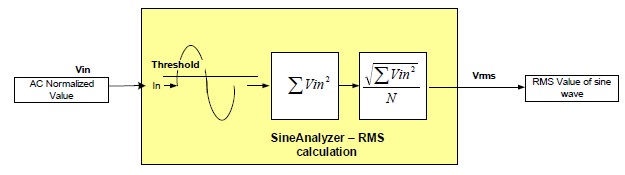
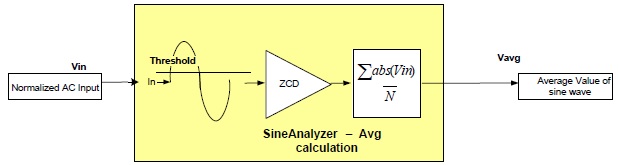
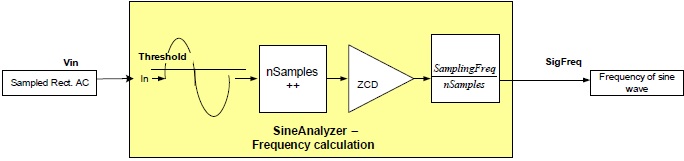
带功率测量的正弦分析仪(POWER_MEAS_SINE_ANALYZER)API 提供一组函数,用于累积采样正弦波输入、检查阈值交叉点以及计算输入正弦波的 RMS、Average 和 EMA 值。该模块还可以计算正弦波的频率并指示零(或阈值)交叉点。
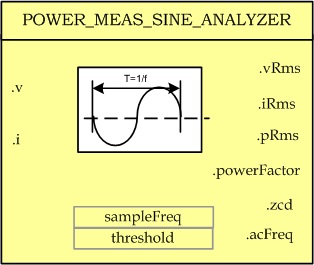
带功率测量模块的正弦分析仪
本模块需要以下关键输入:
- PU 中的电压(v),PU 中的电流(i):这是 ADC 采样的信号,ADC 结果转换为 pu 格式。从阅读中减去偏移,因此对于最大刻度信号,该值将在-1 到 1 之间变化。
- Threshold Value(阈值):阈值用于检测输入信号在阈值集上的交叉,格式为 pu。默认情况下,阈值设置为零。
- 采样频率(sampleFreq):设置为输入正弦波采样的频率,调用正弦分析器模块。
- 正弦周期中的最小和最大样本数(nSamplesMin、nSamplesMax):这些值用于丢弃可能在 rms 和 avg 信号上生成错误值的任何噪声样本。
此模块生成以下关键输出: - 电压、电流和功率 RMS 值(vRms、iRms、pRms):输出以 pu 格式反映输入信号的 RMS 值。在电压和电流的每个阈值交叉点处计算并更新 RMS 值,进一步过滤功率 RMS 值以提供更稳定的输出。
- 功率因数(powerFactor):该值表示输入电流和电压信号的 PF。
- AC 频率(acFreq):该值表示输入信号的 AC 频率。

智能硬件社区聚焦AI智能硬件技术生态,汇聚嵌入式AI、物联网硬件开发者,打造交流分享平台,同步全国赛事资讯、开展 OPC 核心人才招募,助力技术落地与开发者成长。
更多推荐


 1
1 0
0- 0


 已为社区贡献3条内容

所有评论(0)