fatfs使用小结
整体fatfs的移植还是比较方便的。我个人觉得,其实fatfs是不太适合放在mcu使用的nor_flash上面的,因为每次f_open,f_close等操作都会触发文件的写入,而nor_flash每次写都要擦除,即使是一些小的改动也会擦除整个sector。nor_flash的擦写次数在10-100万次,一般都是10万次,所以使用fatfs的寿命可能不会太长。以上是我对fatfs的移植总结~,有什么
一、说明
下载链接:https://elm-chan.org/fsw/ff/
到最下方点击红色方框下载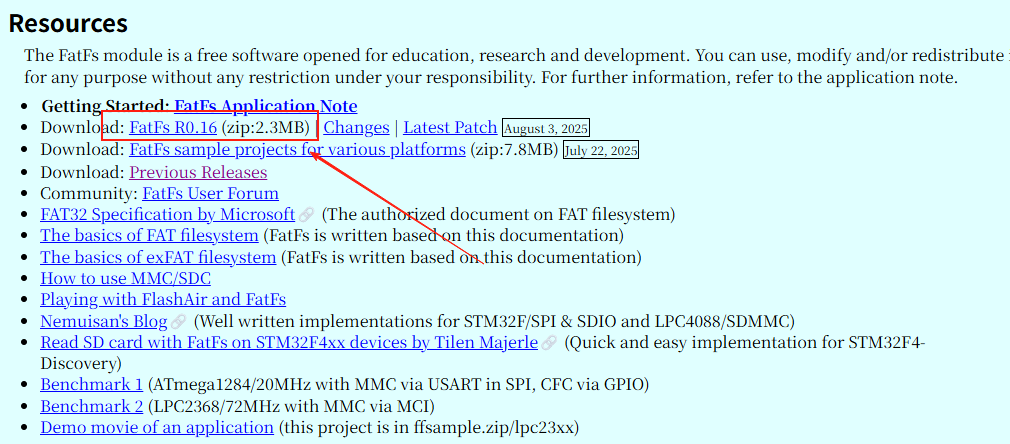
我这里下载的最新版本R0.16,也可以点击Previous Releases下载历史版本。
二、文件移植

下载完成之后,解压得到ff16文件夹,移植只需要source文件当中的.c和.h文件
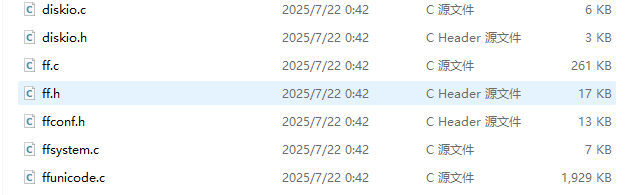
在keil工程中添加fatfs文件夹,在魔术棒中包含h文件路径之后,准备工作就做好了。我这里增加了一个test.c的测试文件,等下的测试就在这里进行。
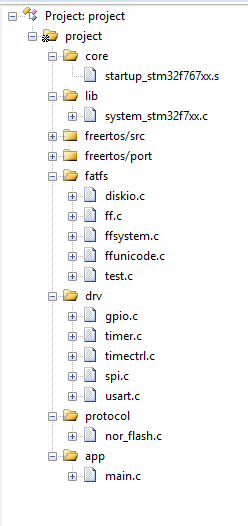
我这里的工程是stm32f767zit6,其中的nor_flash文件是驱动片上的旺宏的nor_flash:MX25Lxx,其余的nor_flash应该也差不多。
三、修改代码
需要修改两个文件:diskio.c和ffconf.h
前面的diskio.c主要是操作对nor_flash的操作访问,包括读写,擦除等等。
ffconf.h主要配置一些宏。
下面是diskio.c的修改部分。
/*-----------------------------------------------------------------------*/
/* Low level disk I/O module SKELETON for FatFs     (C)ChaN, 2025        */
/*-----------------------------------------------------------------------*/
/* If a working storage control module is available, it should be        */
/* attached to the FatFs via a glue function rather than modifying it.   */
/* This is an example of glue functions to attach various exsisting      */
/* storage control modules to the FatFs module with a defined API.       */
/*-----------------------------------------------------------------------*/

#include "ff.h"         /* Basic definitions of FatFs */
#include "diskio.h"     /* Declarations FatFs MAI */

/* Example: Declarations of the platform and disk functions in the project */
#include "Config.h"

/* Example: Mapping of physical drive number for each drive */
#define DEV_FLASH    0  /* Map FTL to physical drive 0 */
#define DEV_MMC      1  /* Map MMC/SD card to physical drive 1 */
#define DEV_USB      2  /* Map USB MSD to physical drive 2 */

DWORD get_fattime(void)
{
   return  ((DWORD)(sys.year+20)<<25) /* -1980 */
          |((DWORD)sys.mon<<21)
          |((DWORD)sys.day<<16)
          |((DWORD)sys.hour<<11)
          |((DWORD)sys.min<<5)
          |((DWORD)sys.sec<<1);
}

/*-----------------------------------------------------------------------*/
/* Get Drive Status                                                      */
/*-----------------------------------------------------------------------*/

DSTATUS disk_status (
   BYTE pdrv      /* Physical drive nmuber to identify the drive */
)
{
   DSTATUS stat;

   switch (pdrv) {
   case DEV_FLASH :
      stat = RES_OK;
      return stat;

   case DEV_MMC :
      return stat;

   case DEV_USB :
      return stat;
   }
   return STA_NOINIT;
}


/*-----------------------------------------------------------------------*/
/* Inidialize a Drive                                                    */
/*-----------------------------------------------------------------------*/

DSTATUS disk_initialize (
   BYTE pdrv            /* Physical drive nmuber to identify the drive */
)
{
   DSTATUS stat;

   switch (pdrv) {
   case DEV_FLASH :
      stat = RES_OK;
      return stat;

   case DEV_MMC :
      return stat;

   case DEV_USB :
      return stat;
   }
   return STA_NOINIT;
}


/*-----------------------------------------------------------------------*/
/* Read Sector(s)                                                        */
/*-----------------------------------------------------------------------*/

DRESULT disk_read (
   BYTE pdrv,     /* Physical drive nmuber to identify the drive */
   BYTE *buff,    /* Data buffer to store read data */
   LBA_t sector,  /* Start sector in LBA */
   UINT count     /* Number of sectors to read */
)
{
   DRESULT res;

   switch (pdrv) {
   case DEV_FLASH :
      nor_flash_rd(sector * NOR_FLASH_SECTOR_SIZE, (unsigned char*)buff, count*NOR_FLASH_SECTOR_SIZE);
      res = RES_OK;
      return res;

   case DEV_MMC :
      return res;

   case DEV_USB :
      return res;
   }

   return RES_PARERR;
}


/*-----------------------------------------------------------------------*/
/* Write Sector(s)                                                       */
/*-----------------------------------------------------------------------*/

#if FF_FS_READONLY == 0

DRESULT disk_write (
   BYTE pdrv,        /* Physical drive nmuber to identify the drive */
   const BYTE *buff, /* Data to be written */
   LBA_t sector,     /* Start sector in LBA */
   UINT count        /* Number of sectors to write */
)
{
   DRESULT res;
   unsigned long cnt;

   switch (pdrv) {
   case DEV_FLASH :
   // printf("write in ---- sector = %d, count = %d\r\n", sector, count);
      for(cnt=0; cnt<count; cnt++)
         { nor_flash_sector_erase((sector + cnt) * NOR_FLASH_SECTOR_SIZE); }
      nor_flash_wt(sector * NOR_FLASH_SECTOR_SIZE, (unsigned char*)buff, count*NOR_FLASH_SECTOR_SIZE);
      res = RES_OK;
      return res;

   case DEV_MMC :
      return res;

   case DEV_USB :
      return res;
   }

   return RES_PARERR;
}

#endif


/*-----------------------------------------------------------------------*/
/* Miscellaneous Functions                                               */
/*-----------------------------------------------------------------------*/

DRESULT disk_ioctl (
   BYTE pdrv,     /* Physical drive nmuber (0..) */
   BYTE cmd,      /* Control code */
   void *buff     /* Buffer to send/receive control data */
)
{
   DRESULT res = RES_OK;
   LBA_t *var_buff, sec_start, sec_end;

   switch (pdrv) {
   case DEV_FLASH :
      switch(cmd)
      {
         /* nor_falsh 驱动层完成了write busy */
         case CTRL_SYNC:
            break;

         /* 所有的扇区数量 */
         case GET_SECTOR_COUNT:
            *(LBA_t*)buff = 512; // NOR_FLASH_MAX_SIZE/NOR_FLASH_SECTOR_SIZE;
            break;

         /* 扇区大小 */
         case GET_SECTOR_SIZE:
            *(WORD*)buff = NOR_FLASH_SECTOR_SIZE;
            break;

         /* deepseek:
            f_mkfs 算法会参考这个值 以及其他参数如磁盘总大小
            计算出最佳的扇区每簇 _SS 数量 并确保簇的起始扇区与块边界对齐 */
         case GET_BLOCK_SIZE:
            *(DWORD*)buff = NOR_FLASH_BLOCK_SIZE / NOR_FLASH_SECTOR_SIZE;
            break;

         /* start sector, sector count */
         case CTRL_TRIM:
            var_buff = (LBA_t*)buff;
            sec_start = var_buff[0];
            sec_end = var_buff[1];

            for(LBA_t cnt=sec_start; cnt<=sec_end; cnt++)
               { nor_flash_sector_erase(cnt * NOR_FLASH_SECTOR_SIZE); }
            break;

         default:
            break;
      }
      return res;

   case DEV_MMC :
      return res;

   case DEV_USB :
      return res;
   }

   return RES_PARERR;
}
disk_status直接返回ok,原因是驱动底层已经做了写等待的操作。
其中disk_write函数,在写入的时候,会先擦除。这是因为fatfs不关心底层驱动,也不做磨损均衡,默认该设备就是可以正常读写的。
disk_ioctl添加了CTRL_SYNC、GET_SECTOR_COUNT、GET_SECTOR_SIZE、GET_BLOCK_SIZE、CTRL_TRIM等宏参数。
CTRL_SYNC:用于同步,这里不用写,也是因为驱动底层已经做了写等待的操作。
GET_SECTOR_COUNT:用于获取扇区数量,我这里测试写的512,实际上我这块nor_flash的扇区数量很多,在格式化文件系统的时候会擦除等待很长时间(这块flash一个扇区的擦除时间最大在400ms),这里测试就写小一点。
GET_SECTOR_SIZE:系统可以计算出磁盘的总大小。
CTRL_TRIM:这个参数其实可以不用写,因为每次disk_write我们都会擦除扇区。这里是当顶层调用f_unlink等函数的时候,擦除该存储位置。
接下来是ffconf.h文件的宏定义修改:
/*---------------------------------------------------------------------------/
/  Configurations of FatFs Module
/---------------------------------------------------------------------------*/
#include "nor_flash.h"

#define FFCONF_DEF  80386   /* Revision ID */

/*---------------------------------------------------------------------------/
/ Function Configurations
/---------------------------------------------------------------------------*/

#define FF_FS_READONLY  0
/* This option switches read-only configuration. (0:Read/Write or 1:Read-only)
/  Read-only configuration removes writing API functions, f_write(), f_sync(),
/  f_unlink(), f_mkdir(), f_chmod(), f_rename(), f_truncate(), f_getfree()
/  and optional writing functions as well. */


#define FF_FS_MINIMIZE  0
/* This option defines minimization level to remove some basic API functions.
/
/   0: Basic functions are fully enabled.
/   1: f_stat(), f_getfree(), f_unlink(), f_mkdir(), f_truncate() and f_rename()
/      are removed.
/   2: f_opendir(), f_readdir() and f_closedir() are removed in addition to 1.
/   3: f_lseek() function is removed in addition to 2. */


#define FF_USE_FIND     0
/* This option switches filtered directory read functions, f_findfirst() and
/  f_findnext(). (0:Disable, 1:Enable 2:Enable with matching altname[] too) */


#define FF_USE_MKFS     1
/* This option switches f_mkfs(). (0:Disable or 1:Enable) */


#define FF_USE_FASTSEEK 0
/* This option switches fast seek feature. (0:Disable or 1:Enable) */


#define FF_USE_EXPAND   0
/* This option switches f_expand(). (0:Disable or 1:Enable) */


#define FF_USE_CHMOD    0
/* This option switches attribute control API functions, f_chmod() and f_utime().
/  (0:Disable or 1:Enable) Also FF_FS_READONLY needs to be 0 to enable this option. */


#define FF_USE_LABEL    0
/* This option switches volume label API functions, f_getlabel() and f_setlabel().
/  (0:Disable or 1:Enable) */


#define FF_USE_FORWARD  0
/* This option switches f_forward(). (0:Disable or 1:Enable) */


#define FF_USE_STRFUNC  1
#define FF_PRINT_LLI    0
#define FF_PRINT_FLOAT  0
#define FF_STRF_ENCODE  0
/* FF_USE_STRFUNC switches string API functions, f_gets(), f_putc(), f_puts() and
/  f_printf().
/
/   0: Disable. FF_PRINT_LLI, FF_PRINT_FLOAT and FF_STRF_ENCODE have no effect.
/   1: Enable without LF-CRLF conversion.
/   2: Enable with LF-CRLF conversion.
/
/  FF_PRINT_LLI = 1 makes f_printf() support long long argument and FF_PRINT_FLOAT = 1/2
/  makes f_printf() support floating point argument. These features want C99 or later.
/  When FF_LFN_UNICODE >= 1 with LFN enabled, string API functions convert the character
/  encoding in it. FF_STRF_ENCODE selects assumption of character encoding ON THE FILE
/  to be read/written via those functions.
/
/   0: ANSI/OEM in current CP
/   1: Unicode in UTF-16LE
/   2: Unicode in UTF-16BE
/   3: Unicode in UTF-8
*/


/*---------------------------------------------------------------------------/
/ Locale and Namespace Configurations
/---------------------------------------------------------------------------*/

#define FF_CODE_PAGE    437
/* This option specifies the OEM code page to be used on the target system.
/  Incorrect code page setting can cause a file open failure.
/
/   437 - U.S.
/   720 - Arabic
/   737 - Greek
/   771 - KBL
/   775 - Baltic
/   850 - Latin 1
/   852 - Latin 2
/   855 - Cyrillic
/   857 - Turkish
/   860 - Portuguese
/   861 - Icelandic
/   862 - Hebrew
/   863 - Canadian French
/   864 - Arabic
/   865 - Nordic
/   866 - Russian
/   869 - Greek 2
/   932 - Japanese (DBCS)
/   936 - Simplified Chinese (DBCS)
/   949 - Korean (DBCS)
/   950 - Traditional Chinese (DBCS)
/     0 - Include all code pages above and configured by f_setcp()
*/


#define FF_USE_LFN      1
#define FF_MAX_LFN      255
/* The FF_USE_LFN switches the support for LFN (long file name).
/
/   0: Disable LFN. FF_MAX_LFN has no effect.
/   1: Enable LFN with static working buffer on the BSS. Always NOT thread-safe.
/   2: Enable LFN with dynamic working buffer on the STACK.
/   3: Enable LFN with dynamic working buffer on the HEAP.
/
/  To enable the LFN, ffunicode.c needs to be added to the project. The LFN feature
/  requiers certain internal working buffer occupies (FF_MAX_LFN + 1) * 2 bytes and
/  additional (FF_MAX_LFN + 44) / 15 * 32 bytes when exFAT is enabled.
/  The FF_MAX_LFN defines size of the working buffer in UTF-16 code unit and it can
/  be in range of 12 to 255. It is recommended to be set 255 to fully support the LFN
/  specification.
/  When use stack for the working buffer, take care on stack overflow. When use heap
/  memory for the working buffer, memory management functions, ff_memalloc() and
/  ff_memfree() exemplified in ffsystem.c, need to be added to the project. */


#define FF_LFN_UNICODE  2
/* This option switches the character encoding on the API when LFN is enabled.
/
/   0: ANSI/OEM in current CP (TCHAR = char)
/   1: Unicode in UTF-16 (TCHAR = WCHAR)
/   2: Unicode in UTF-8 (TCHAR = char)
/   3: Unicode in UTF-32 (TCHAR = DWORD)
/
/  Also behavior of string I/O functions will be affected by this option.
/  When LFN is not enabled, this option has no effect. */


#define FF_LFN_BUF      255
#define FF_SFN_BUF      12
/* This set of options defines size of file name members in the FILINFO structure
/  which is used to read out directory items. These values should be suffcient for
/  the file names to read. The maximum possible length of the read file name depends
/  on character encoding. When LFN is not enabled, these options have no effect. */


#define FF_FS_RPATH     0
/* This option configures support for relative path feature.
/
/   0: Disable relative path and remove related API functions.
/   1: Enable relative path and dot names. f_chdir() and f_chdrive() are available.
/   2: f_getcwd() is available in addition to 1.
*/


#define FF_PATH_DEPTH   10
/*  This option defines maximum depth of directory in the exFAT volume. It is NOT
/   relevant to FAT/FAT32 volume.
/   For example, FF_PATH_DEPTH = 3 will able to follow a path "/dir1/dir2/dir3/file"
/   but a sub-directory in the dir3 will not able to be followed and set current
/   directory.
/   The size of filesystem object (FATFS) increases FF_PATH_DEPTH * 24 bytes.
/   When FF_FS_EXFAT == 0 or FF_FS_RPATH == 0, this option has no effect.
*/


/*---------------------------------------------------------------------------/
/ Drive/Volume Configurations
/---------------------------------------------------------------------------*/

#define FF_VOLUMES      1
/* Number of volumes (logical drives) to be used. (1-10) */


#define FF_STR_VOLUME_ID    0
#define FF_VOLUME_STRS      "RAM","NAND","CF","SD","SD2","USB","USB2","USB3"
/* FF_STR_VOLUME_ID switches support for volume ID in arbitrary strings.
/  When FF_STR_VOLUME_ID is set to 1 or 2, arbitrary strings can be used as drive
/  number in the path name. FF_VOLUME_STRS defines the volume ID strings for each
/  logical drive. Number of items must not be less than FF_VOLUMES. Valid
/  characters for the volume ID strings are A-Z, a-z and 0-9, however, they are
/  compared in case-insensitive. If FF_STR_VOLUME_ID >= 1 and FF_VOLUME_STRS is
/  not defined, a user defined volume string table is needed as:
/
/  const char* VolumeStr[FF_VOLUMES] = {"ram","flash","sd","usb",...
*/


#define FF_MULTI_PARTITION  0
/* This option switches support for multiple volumes on the physical drive.
/  By default (0), each logical drive number is bound to the same physical drive
/  number and only an FAT volume found on the physical drive will be mounted.
/  When this feature is enabled (1), each logical drive number can be bound to
/  arbitrary physical drive and partition listed in the VolToPart[]. Also f_fdisk()
/  will be available. */


#define FF_MIN_SS       NOR_FLASH_SECTOR_SIZE
#define FF_MAX_SS       NOR_FLASH_SECTOR_SIZE
/* This set of options configures the range of sector size to be supported. (512,
/  1024, 2048 or 4096) Always set both 512 for most systems, generic memory card and
/  harddisk, but a larger value may be required for on-board flash memory and some
/  type of optical media. When FF_MAX_SS is larger than FF_MIN_SS, FatFs is
/  configured for variable sector size mode and disk_ioctl() needs to implement
/  GET_SECTOR_SIZE command. */


#define FF_LBA64        0
/* This option switches support for 64-bit LBA. (0:Disable or 1:Enable)
/  To enable the 64-bit LBA, also exFAT needs to be enabled. (FF_FS_EXFAT == 1) */


#define FF_MIN_GPT      0x10000000
/* Minimum number of sectors to switch GPT as partitioning format in f_mkfs() and
/  f_fdisk(). 2^32 sectors maximum. This option has no effect when FF_LBA64 == 0. */


#define FF_USE_TRIM     1
/* This option switches support for ATA-TRIM. (0:Disable or 1:Enable)
/  To enable this feature, also CTRL_TRIM command should be implemented to
/  the disk_ioctl(). */


/*---------------------------------------------------------------------------/
/ System Configurations
/---------------------------------------------------------------------------*/

#define FF_FS_TINY      1
/* This option switches tiny buffer configuration. (0:Normal or 1:Tiny)
/  At the tiny configuration, size of file object (FIL) is reduced FF_MAX_SS bytes.
/  Instead of private sector buffer eliminated from the file object, common sector
/  buffer in the filesystem object (FATFS) is used for the file data transfer. */


#define FF_FS_EXFAT     0
/* This option switches support for exFAT filesystem. (0:Disable or 1:Enable)
/  To enable exFAT, also LFN needs to be enabled. (FF_USE_LFN >= 1)
/  Note that enabling exFAT discards ANSI C (C89) compatibility. */


#define FF_FS_NORTC     0
#define FF_NORTC_MON    1
#define FF_NORTC_MDAY   1
#define FF_NORTC_YEAR   2025
/* The option FF_FS_NORTC switches timestamp feature. If the system does not have
/  an RTC or valid timestamp is not needed, set FF_FS_NORTC = 1 to disable the
/  timestamp feature. Every object modified by FatFs will have a fixed timestamp
/  defined by FF_NORTC_MON, FF_NORTC_MDAY and FF_NORTC_YEAR in local time.
/  To enable timestamp function (FF_FS_NORTC = 0), get_fattime() need to be added
/  to the project to read current time form real-time clock. FF_NORTC_MON,
/  FF_NORTC_MDAY and FF_NORTC_YEAR have no effect.
/  These options have no effect in read-only configuration (FF_FS_READONLY = 1). */


#define FF_FS_CRTIME    0
/* This option enables(1)/disables(0) the timestamp of the file created. When
/  set 1, the file created time is available in FILINFO structure. */


#define FF_FS_NOFSINFO  0
/* If you need to know the correct free space on the FAT32 volume, set bit 0 of
/  this option, and f_getfree() on the first time after volume mount will force
/  a full FAT scan. Bit 1 controls the use of last allocated cluster number.
/
/  bit0=0: Use free cluster count in the FSINFO if available.
/  bit0=1: Do not trust free cluster count in the FSINFO.
/  bit1=0: Use last allocated cluster number in the FSINFO if available.
/  bit1=1: Do not trust last allocated cluster number in the FSINFO.
*/


#define FF_FS_LOCK      0
/* The option FF_FS_LOCK switches file lock function to control duplicated file open
/  and illegal operation to open objects. This option must be 0 when FF_FS_READONLY
/  is 1.
/
/  0:  Disable file lock function. To avoid volume corruption, application program
/      should avoid illegal open, remove and rename to the open objects.
/  >0: Enable file lock function. The value defines how many files/sub-directories
/      can be opened simultaneously under file lock control. Note that the file
/      lock control is independent of re-entrancy. */


#define FF_FS_REENTRANT 0
#define FF_FS_TIMEOUT   1000
/* The option FF_FS_REENTRANT switches the re-entrancy (thread safe) of the FatFs
/  module itself. Note that regardless of this option, file access to different
/  volume is always re-entrant and volume control functions, f_mount(), f_mkfs()
/  and f_fdisk(), are always not re-entrant. Only file/directory access to
/  the same volume is under control of this featuer.
/
/   0: Disable re-entrancy. FF_FS_TIMEOUT have no effect.
/   1: Enable re-entrancy. Also user provided synchronization handlers,
/      ff_mutex_create(), ff_mutex_delete(), ff_mutex_take() and ff_mutex_give(),
/      must be added to the project. Samples are available in ffsystem.c.
/
/  The FF_FS_TIMEOUT defines timeout period in unit of O/S time tick.
*/


/*--- End of configuration options ---*/
主要修改:
FF_FS_TINY:使用 Tiny 模式,节省 RAM
FF_USE_MKFS:设置为 1,使能格式化功能,首次使用 Flash 时需要。
USE_TRIM:启用 disk_ioctl中的 USE_TRIM命令,FATFS 通过它来通知底层哪些扇区可以擦除。这里其实可以不用的。原因就是每次写入实际都做了擦除的。
FF_VOLUMES:卷数量,我这里只有一个就设置1
FF_MIN_SS,FF_MAX_SS:扇区大小,如果只有一个存储器,都设置一样。有多个存储器,按照最小的和最大的来设置。
FF_USE_STRFUNC:用于打印会输出时间,这里写1之后需要定义get_fattime函数,我放在diskio.c中的。
FF_CODE_PAGE:437 使用us,中文库太大了。
FF_USE_LFN:文件名,占用的内存放在哪里。
FF_LFN_UNICODE:2,使用ytf-8编码。
四、运行测试
到这里我们就可以开始编译测试了,这里是测试代码:
#include "Config.h"
#include "ff.h"
#include <stdlib.h>

static timeCtrl nor_flash_dly;
static SemaphoreHandle_t nor_flash_mutex;

static unsigned char nor_flash_spi_send(unsigned char data)
   { return spi_send(SPI5, data); }

static void nor_flash_cs(unsigned char status)
   { IO_SET(GPIOF, 6, CMP_VALUE(status, 0, 0, 1)); }

static void nor_flash_dly_us(unsigned short us)
   { dly_us(&nor_flash_dly, us); }

static void nor_flash_lock(unsigned char cmd)
{
   if(cmd)
        { xSemaphoreTake(nor_flash_mutex, portMAX_DELAY); }
   else { xSemaphoreGive(nor_flash_mutex); }
}

static char* ret_order_index_to_char(unsigned int index)
{
   static char buff[20];

   memset(buff, 0 ,20);

   snprintf((char*)buff, 20, "wt_index = %d", index);

   return buff;
}

struct _data
{
   unsigned long index;
   unsigned long data_len;
   unsigned char data[2048];
   unsigned char desc[32];
};

/* fatfs */
FATFS fs; /* 文件系统对象 */
MKFS_PARM opt;
FIL fp_obj; /* 文件对象 */
char *write_data = "hello fatfs!";
unsigned int write_bytes, read_bytes;
char work_buff[FF_MAX_SS];
unsigned char key_wt, key_rd, key_delete;
unsigned int wt_no, rd_no;
unsigned int wt_index, rd_index, delete_index;
unsigned char wt_err, rd_err;
struct _data wt_data, rd_data;

#define PATH ""

void fatfs_test(void *para)
{
   FRESULT ret;

   nor_flash_mutex = xSemaphoreCreateMutex();

   nor_flash_init(nor_flash_spi_send, nor_flash_cs, nor_flash_dly_us, nor_flash_lock);

   /* 立即挂载 */
   ret = f_mount(&fs, PATH, 1);

   if(ret == FR_NO_FILESYSTEM)
   {
      PRINTF("no filesystem found. formatting...\n");

      opt.fmt     = FM_FAT;    /* 文件系统类型 */
      opt.n_fat   = 0;         /* 0表示默认值 */
      opt.align   = 0;
      opt.n_root  = 0;
      opt.au_size = FF_MAX_SS; /* 簇大小 */

      /* 格式化 这会触发全片擦除和FAT结构写入 */
      ret = f_mkfs(PATH, &opt, work_buff, FF_MAX_SS);

      if(ret == FR_OK)
      {
         PRINTF("f_mount again\n");

         /* 重新挂载 */
         ret = f_mount(&fs, PATH, 1);

         if(ret == FR_OK) { PRINTF("filesystem success\n"); }
         else { PRINTF("filesystem fail again\n"); }
      }
      else
      {
         PRINTF("format error: %d\n", ret);
      }
   }
   else if(ret != FR_OK)
   {
      PRINTF("mount error: %d\n", ret);
   }

   for(;;)
   {
      u1_process();

      if(key_wt == 1)
      {
         key_wt = 0;

         wt_err = 0;

         wt_index = wt_no;

         memset(&wt_data, 0, sizeof(struct _data));
         wt_data.index = wt_index;
         memcpy(wt_data.data, write_data, strlen(write_data));
         wt_data.data_len = strlen(write_data);
         snprintf((char*)wt_data.desc, 20, "wt cnt = %d", wt_index);

         ret = FR_OK;
         ret = f_open(&fp_obj, ret_order_index_to_char(wt_index), FA_WRITE | FA_CREATE_ALWAYS);

         if(!ret) { PRINTF("write open file success!\n"); }
         else { PRINTF("write open file failure! code = %d\n", ret); wt_err = 1; }

         ret = FR_OK;
         ret = f_write(&fp_obj, (char*)&wt_data, sizeof(struct _data), &write_bytes);
         if(!ret) { PRINTF("write success, write_bytes=%d\n", write_bytes); }
         else { PRINTF("write failure! code = %d\n", ret); wt_err = 1; }

         ret = FR_OK;
         ret = f_close(&fp_obj);
         if(!ret) PRINTF("write close success!\n");
         else { PRINTF("write close failure! code = %d\n", ret); wt_err = 1; }

         if(!wt_err)
         {
            PRINTF("wt_data.index :%d\n", (int)wt_data.index);
            PRINTF("wt_data.data :%s\n", wt_data.data);
            PRINTF("wt_data.data_len :%d\n", (int)wt_data.data_len);
            PRINTF("wt_data.desc :%s\n", wt_data.desc);
         }
      }

      if(key_rd == 1)
      {
         key_rd = 0;

         rd_err = 0;

         memset(&rd_data, 0, sizeof(struct _data));

         rd_index = rd_no;

         ret = FR_OK;
         ret = f_open(&fp_obj, ret_order_index_to_char(rd_index), FA_OPEN_EXISTING | FA_READ);
         if(!ret) { PRINTF("read open file success!\n"); }
         else { PRINTF("read open file failure! code = %d\n", ret); rd_err = 1; }

         ret = FR_OK;
         ret = f_read(&fp_obj, (char*)&rd_data, sizeof(struct _data), &read_bytes);
         if(!ret)
         {
            PRINTF("read success, read_bytes=%d\n", read_bytes);

            PRINTF("rd_data.index :%d\n", (int)rd_data.index);
            PRINTF("rd_data.data :%s\n", rd_data.data);
            PRINTF("rd_data.data_len :%d\n", (int)rd_data.data_len);
            PRINTF("rd_data.desc :%s\n", rd_data.desc);
         }
         else { PRINTF("read failure! code = %d\n", ret); rd_err = 1; }

         ret = FR_OK;
         ret = f_close(&fp_obj);
         if(!ret) { PRINTF("read close success!\n"); }
         else { PRINTF("read close failure! code = %d\n", ret); rd_err = 1; }
      }

      if(key_delete == 1)
      {
         key_delete = 0;

         ret = FR_OK;
         ret = f_unlink(ret_order_index_to_char(delete_index));
         if(!ret) { PRINTF("File deleted successfully.\n");}
         else { PRINTF("Error deleting file! code = %d\n", ret); }
      }

      vTaskDelay(1000);
   }
}
我这里的测试逻辑是使用串口,输入指令来控制读写和删除:

前面的nor_flash_init初始化,包含了对spi的读写注册,片选,一个us延时用于最大的超时等待计时,可以传入osDelay也可以,互斥锁等参数。
注册nor_flash驱动之后我们挂载文件系统。
ret = f_mount(&fs, PATH, 1);没有文件系统会调用f_mkfs()初始化。之后的重启就不会调用f_mkfs了。
测试结果:
写入:输入01 01,读取:02 01,擦除:03 01,再次读取:02 01
(01 02 03分别是串口设置的写入,读取,擦除,后面跟着的是文件编号)
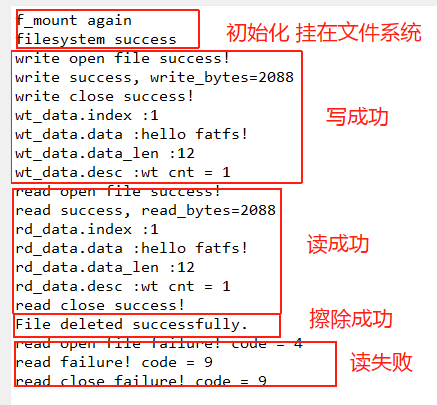
到这里就测试结束了。
五、总结
整体fatfs的移植还是比较方便的。我个人觉得,其实fatfs是不太适合放在mcu使用的nor_flash上面的,因为每次f_open,f_close等操作都会触发文件的写入,而nor_flash每次写都要擦除,即使是一些小的改动也会擦除整个sector。nor_flash的擦写次数在10-100万次,一般都是10万次,所以使用fatfs的寿命可能不会太长。
以上是我对fatfs的移植总结~,有什么写错的地方希望看到的读者能指出来,大家共同进步~
下次总结一下littlefs文件系统的移植。

智能硬件社区聚焦AI智能硬件技术生态,汇聚嵌入式AI、物联网硬件开发者,打造交流分享平台,同步全国赛事资讯、开展 OPC 核心人才招募,助力技术落地与开发者成长。
更多推荐



 17
17 0
0- 0


 已为社区贡献1条内容

所有评论(0)