【HAL库+cubeMX基础】利用ADC规则通道和注入通道读取传感器数据
·
ADC规则通道
规则通道用于常规的模数转换任务,通常按预定义的顺序扫描多个输入通道。规则通道组中的通道转换顺序可编程,转换结果存储在固定的数据寄存器中。规则通道适用于需要连续或周期性采样多个模拟信号的场景,例如多路传感器数据采集。
ADC注入通道
注入通道用于高优先级的中断式模数转换,可打断规则通道的转换过程。注入通道组支持最多4个通道,转换顺序和触发条件独立于规则通道。转换结果存储在专用的注入数据寄存器中。注入通道适用于需要快速响应紧急事件的场景,例如过压保护或故障检测。
主要区别
- 优先级:注入通道可抢占规则通道的转换,响应延迟更低。
- 寄存器:规则通道使用DR寄存器,注入通道使用JDRx寄存器。
- 触发方式:规则通道通常由定时器触发,注入通道支持外部触发或软件触发。
- 队列长度:规则通道组支持更多通道(如16个),注入通道通常限制为4个。
注:具体特性可能因芯片型号(如STM32)而异,需参考对应参考手册确认细节。
本实验是基于STM32f1HAL库利用ADC规则通道和注入通道读取传感器数据
CubeMX配置
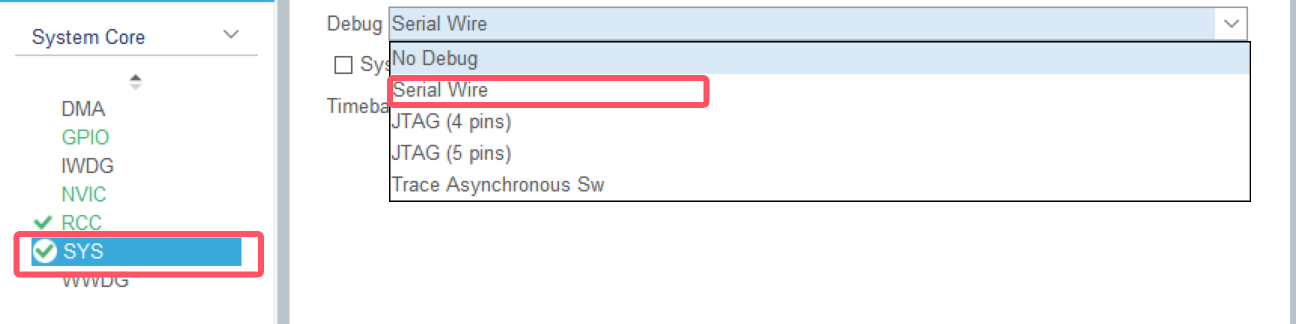
在CubeMX选配好单片机后点击【System Core】——【SYS】——【Debug】选择Serial Wire
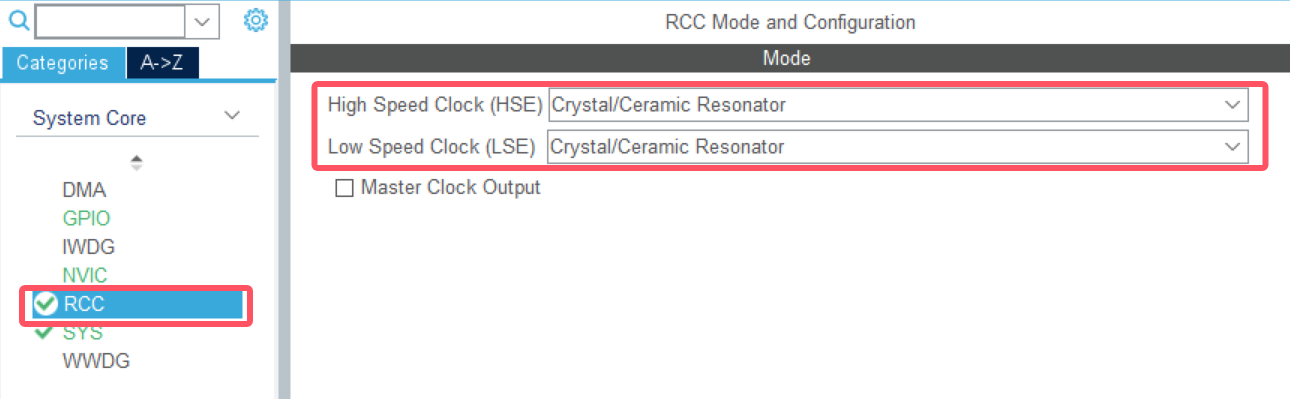
然后配置时钟,点击【RCC】在高速时钟和低速时钟选择晶振
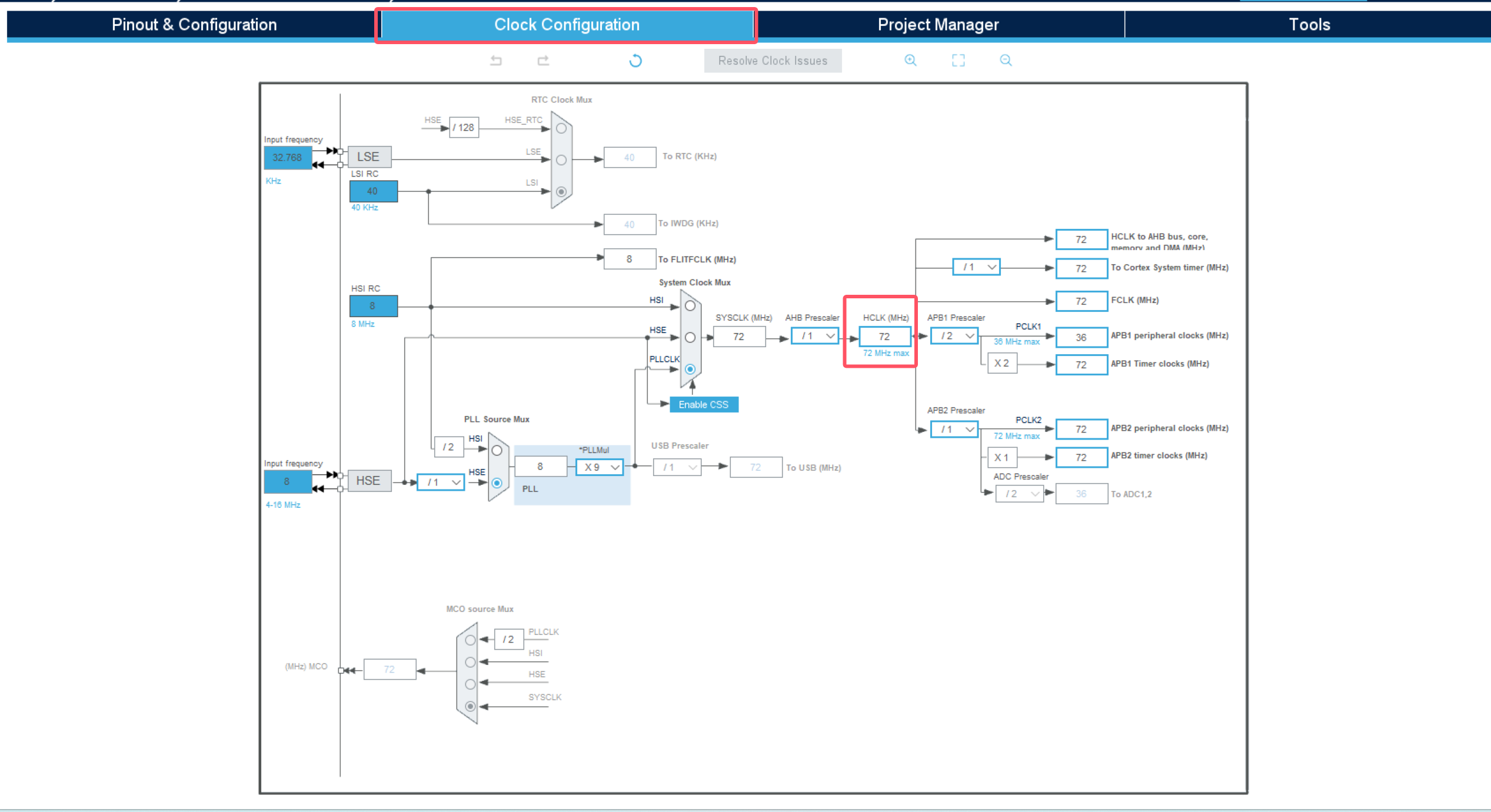
然后将时钟配置为72MHz
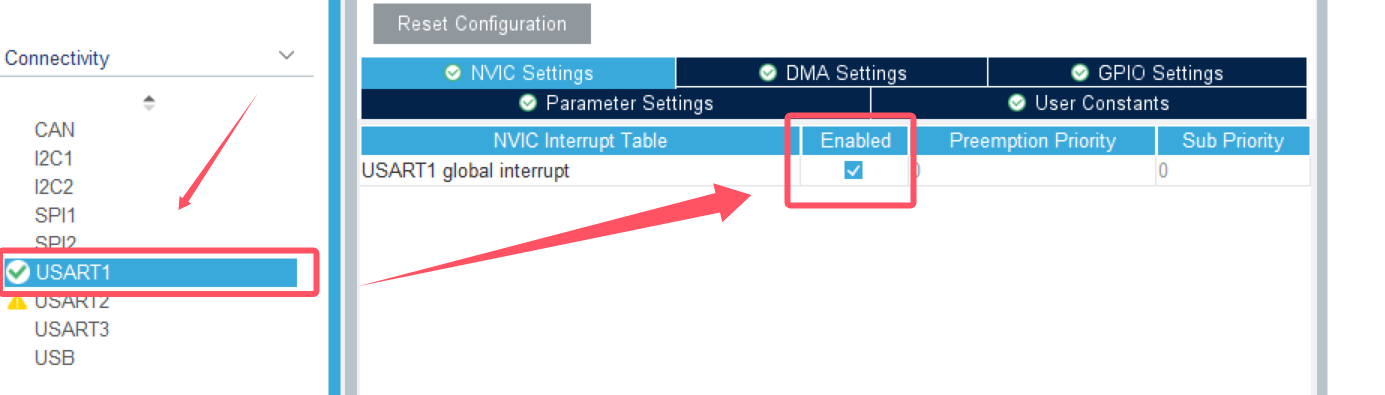
打开USART1方便单片机与电脑通过CH340连接
点击【Analog】——【ADC1】选择通道4和通道5
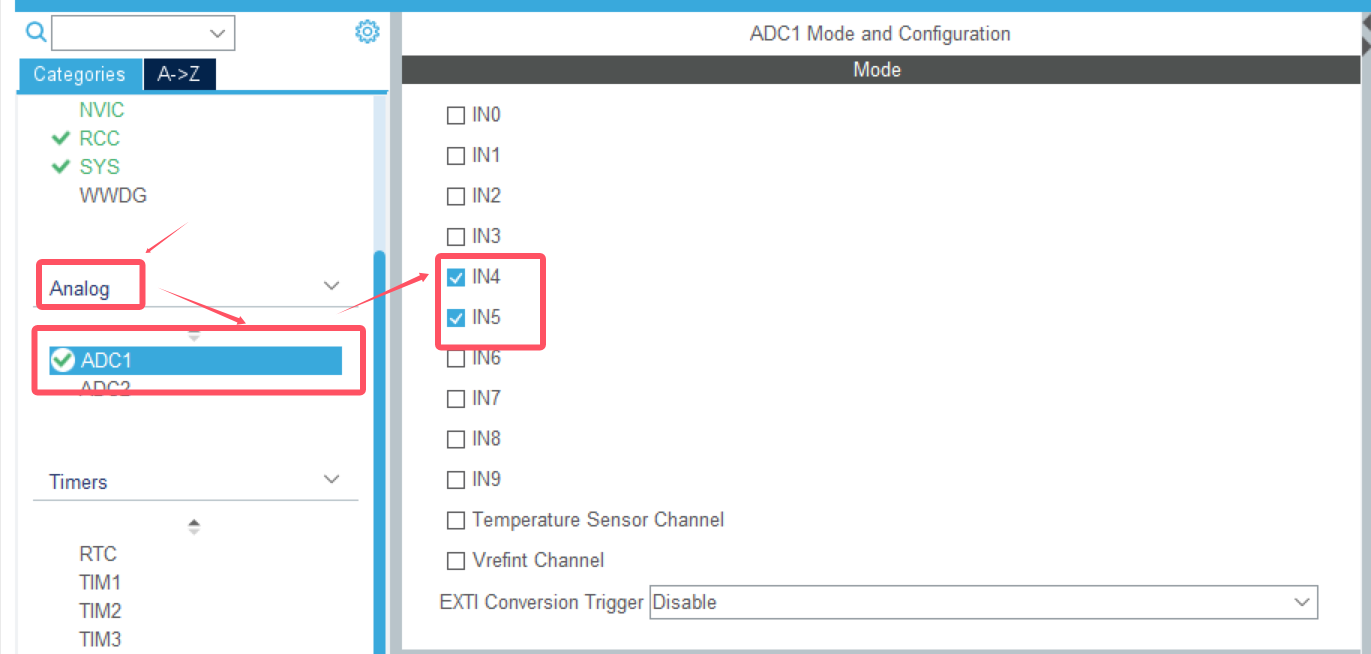
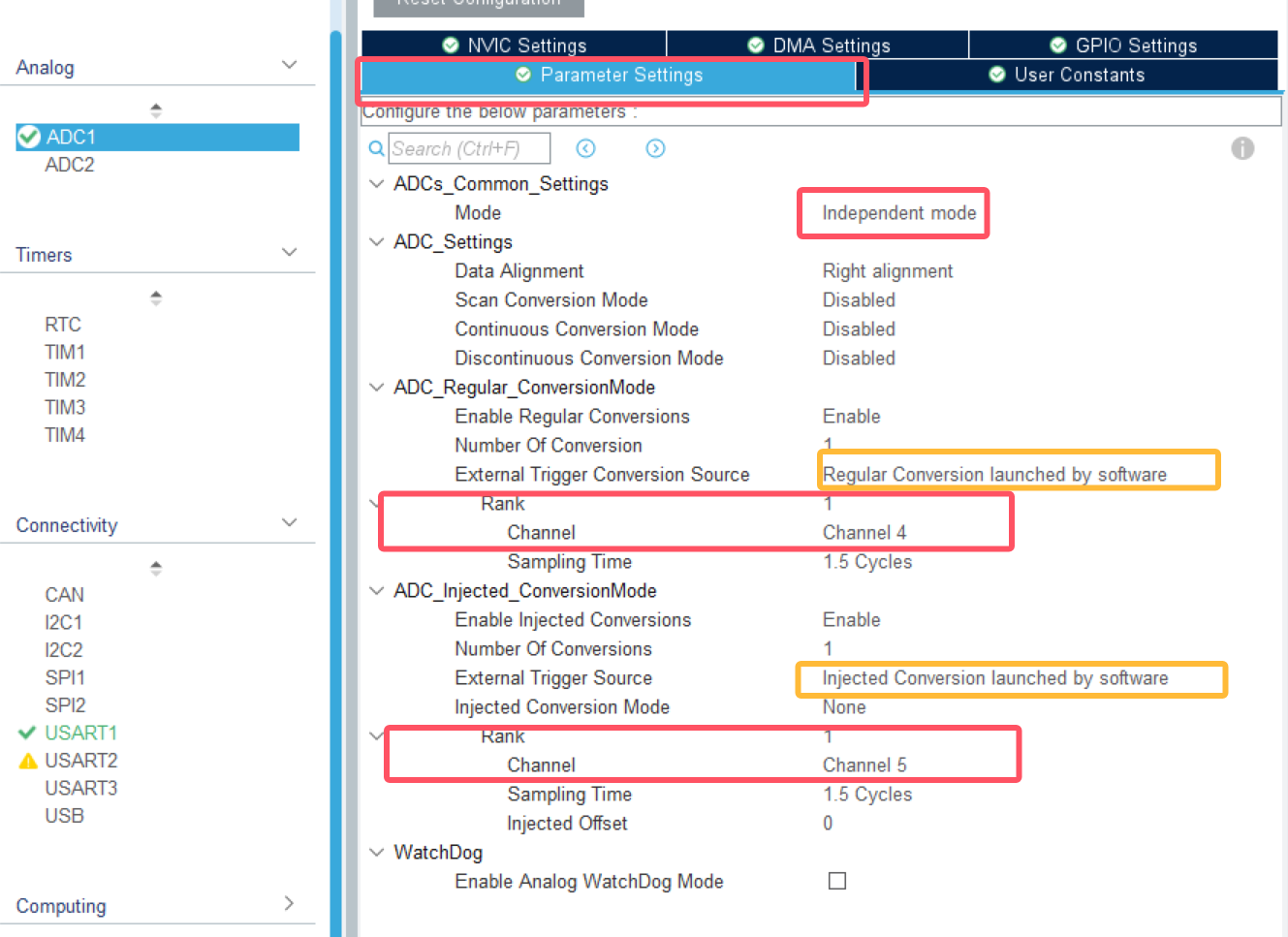
打开ADC中断后对其进行配置(注意通道4为规则通道,通道5为注入通道)
代码部分
将CubeMX配置好后,新建文件名,选择【MDK-ARM】后就可以编写代码了
/* USER CODE BEGIN Header */
/**
  ******************************************************************************
  * @file           : main.c
  * @brief          : Main program body
  ******************************************************************************
  * @attention
  *
  * Copyright (c) 2025 STMicroelectronics.
  * All rights reserved.
  *
  * This software is licensed under terms that can be found in the LICENSE file
  * in the root directory of this software component.
  * If no LICENSE file comes with this software, it is provided AS-IS.
  *
  ******************************************************************************
  */
/* USER CODE END Header */
/* Includes ------------------------------------------------------------------*/
#include "main.h"
#include "adc.h"
#include "usart.h"
#include "gpio.h"

/* Private includes ----------------------------------------------------------*/
/* USER CODE BEGIN Includes */

#include<stdio.h>
#include<string.h>
#include<math.h>

/* USER CODE END Includes */

/* Private typedef -----------------------------------------------------------*/
/* USER CODE BEGIN PTD */

/* USER CODE END PTD */

/* Private define ------------------------------------------------------------*/
/* USER CODE BEGIN PD */

/* USER CODE END PD */

/* Private macro -------------------------------------------------------------*/
/* USER CODE BEGIN PM */

/* USER CODE END PM */

/* Private variables ---------------------------------------------------------*/

/* USER CODE BEGIN PV */

uint32_t adc_val[2];//存储传感器ADC的值
float voltage [2];//存储传感器ADC电压

/* USER CODE END PV */

/* Private function prototypes -----------------------------------------------*/
void SystemClock_Config(void);
/* USER CODE BEGIN PFP */

/* USER CODE END PFP */

/* Private user code ---------------------------------------------------------*/
/* USER CODE BEGIN 0 */

/* USER CODE END 0 */

/**
  * @brief  The application entry point.
  * @retval int
  */
int main(void)
{

  /* USER CODE BEGIN 1 */

  /* USER CODE END 1 */

  /* MCU Configuration--------------------------------------------------------*/

  /* Reset of all peripherals, Initializes the Flash interface and the Systick. */
  HAL_Init();

  /* USER CODE BEGIN Init */

  /* USER CODE END Init */

  /* Configure the system clock */
  SystemClock_Config();

  /* USER CODE BEGIN SysInit */

  /* USER CODE END SysInit */

  /* Initialize all configured peripherals */
  MX_GPIO_Init();
  MX_ADC1_Init();
  MX_USART1_UART_Init();
  /* USER CODE BEGIN 2 */

HAL_ADCEx_Calibration_Start(&hadc1);//校准ADC

  /* USER CODE END 2 */

  /* Infinite loop */
  /* USER CODE BEGIN WHILE */
  while (1)
  {

		HAL_ADC_Start_IT (&hadc1);//启用一次中断读取ADC
		HAL_ADCEx_InjectedStart_IT (&hadc1);//启用一次中断读取注入通到ADC

		HAL_Delay(500);//每500ms读取一次

		voltage[0] = (float)adc_val [0] / 4095 *3.3f;
		voltage[1] = (float)adc_val [1] / 4095 *3.3f;

		printf("\r\n距离传感器(规则通道IN4):%f,温度传感器(注入通道IN5):%f\r\n",
						voltage[0],voltage[1]);


    /* USER CODE END WHILE */

    /* USER CODE BEGIN 3 */
  }
  /* USER CODE END 3 */
}

/**
  * @brief System Clock Configuration
  * @retval None
  */
void SystemClock_Config(void)
{
  RCC_OscInitTypeDef RCC_OscInitStruct = {0};
  RCC_ClkInitTypeDef RCC_ClkInitStruct = {0};
  RCC_PeriphCLKInitTypeDef PeriphClkInit = {0};

  /** Initializes the RCC Oscillators according to the specified parameters
  * in the RCC_OscInitTypeDef structure.
  */
  RCC_OscInitStruct.OscillatorType = RCC_OSCILLATORTYPE_HSE;
  RCC_OscInitStruct.HSEState = RCC_HSE_ON;
  RCC_OscInitStruct.HSEPredivValue = RCC_HSE_PREDIV_DIV1;
  RCC_OscInitStruct.HSIState = RCC_HSI_ON;
  RCC_OscInitStruct.PLL.PLLState = RCC_PLL_ON;
  RCC_OscInitStruct.PLL.PLLSource = RCC_PLLSOURCE_HSE;
  RCC_OscInitStruct.PLL.PLLMUL = RCC_PLL_MUL9;
  if (HAL_RCC_OscConfig(&RCC_OscInitStruct) != HAL_OK)
  {
    Error_Handler();
  }

  /** Initializes the CPU, AHB and APB buses clocks
  */
  RCC_ClkInitStruct.ClockType = RCC_CLOCKTYPE_HCLK|RCC_CLOCKTYPE_SYSCLK
                              |RCC_CLOCKTYPE_PCLK1|RCC_CLOCKTYPE_PCLK2;
  RCC_ClkInitStruct.SYSCLKSource = RCC_SYSCLKSOURCE_PLLCLK;
  RCC_ClkInitStruct.AHBCLKDivider = RCC_SYSCLK_DIV1;
  RCC_ClkInitStruct.APB1CLKDivider = RCC_HCLK_DIV2;
  RCC_ClkInitStruct.APB2CLKDivider = RCC_HCLK_DIV1;

  if (HAL_RCC_ClockConfig(&RCC_ClkInitStruct, FLASH_LATENCY_2) != HAL_OK)
  {
    Error_Handler();
  }
  PeriphClkInit.PeriphClockSelection = RCC_PERIPHCLK_ADC;
  PeriphClkInit.AdcClockSelection = RCC_ADCPCLK2_DIV6;
  if (HAL_RCCEx_PeriphCLKConfig(&PeriphClkInit) != HAL_OK)
  {
    Error_Handler();
  }
}

/* USER CODE BEGIN 4 */

//
void HAL_ADC_ConvCpltCallback(ADC_HandleTypeDef*hadc)
{
		if(hadc -> Instance == ADC1 )
		{
				//读取ADC1的转换结果,并保存
				adc_val [0] = HAL_ADC_GetValue(hadc);
		}
}

void HAL_ADCEx_InjectedConvCpltCallback(ADC_HandleTypeDef*hadc)
{
		if(hadc -> Instance == ADC1)
		{
				//读取ADC1的注入通道转换结果,并保存
				adc_val [1] = HAL_ADCEx_InjectedGetValue (hadc,ADC_INJECTED_RANK_1);
		}
}

int fputc(int ch , FILE *f)
{
HAL_UART_Transmit(&huart1 , (uint8_t*)&ch,1,HAL_MAX_DELAY);
	return ch;
}

/* USER CODE END 4 */

/**
  * @brief  This function is executed in case of error occurrence.
  * @retval None
  */
void Error_Handler(void)
{
  /* USER CODE BEGIN Error_Handler_Debug */
  /* User can add his own implementation to report the HAL error return state */
  __disable_irq();
  while (1)
  {
  }
  /* USER CODE END Error_Handler_Debug */
}

#ifdef  USE_FULL_ASSERT
/**
  * @brief  Reports the name of the source file and the source line number
  *         where the assert_param error has occurred.
  * @param  file: pointer to the source file name
  * @param  line: assert_param error line source number
  * @retval None
  */
void assert_failed(uint8_t *file, uint32_t line)
{
  /* USER CODE BEGIN 6 */
  /* User can add his own implementation to report the file name and line number,
     ex: printf("Wrong parameters value: file %s on line %d\r\n", file, line) */
  /* USER CODE END 6 */
}
#endif /* USE_FULL_ASSERT */
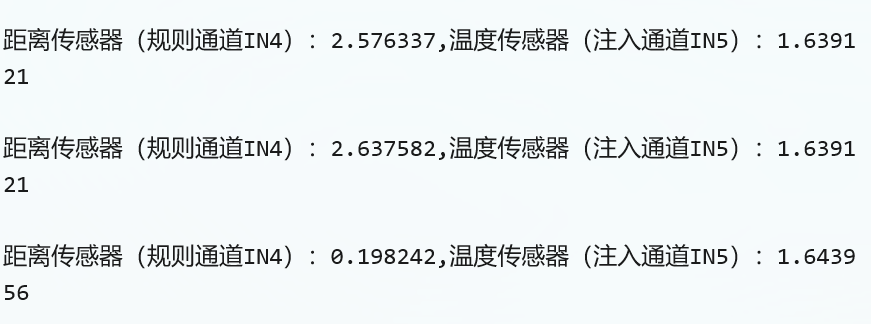
实验现象如下所示:

智能硬件社区聚焦AI智能硬件技术生态,汇聚嵌入式AI、物联网硬件开发者,打造交流分享平台,同步全国赛事资讯、开展 OPC 核心人才招募,助力技术落地与开发者成长。
更多推荐


 9
9 0
0- 0


 已为社区贡献6条内容

所有评论(0)