基于STM32完成M3508电机PID速度环和角度环控制以及过零处理
PID_clac函数是PID计算函数,填入PID结构体指针,反馈数据(即读到的电机数据),设定值,即可输出PID计算结果;将角度外环的输出结果作为速度内环的SET值,再将速度环的输出给电机函数,即可完成串环控制。先定义pid速度环和角度环结构体变量,再分别给这两个环的PID三参赋值。这个函数写的是每按下一次按键,编码增加1024;创建电机结构体变量,用于接收电机数据。再加入CAN屏蔽器初始化。具体
·
首先用CubeMX生成一个项目
具体步骤在下面这篇有讲基于stm32f103的HAL库CAN通信控制3508电机开环转动,以及Cube软件如何配置。_stm32f103 hal can-CSDN博客
然后生成项目之后,加入bsp文件
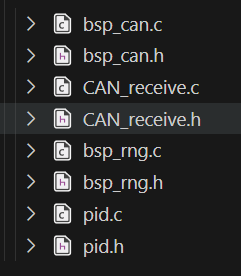
bsp_can.c
#include "bsp_can.h"//1
#include "main.h"


extern CAN_HandleTypeDef hcan;

void can_filter_init(void)
{
    CAN_FilterTypeDef can_filter_st;
    can_filter_st.FilterActivation = ENABLE;
    can_filter_st.FilterMode = CAN_FILTERMODE_IDMASK;
    can_filter_st.FilterScale = CAN_FILTERSCALE_32BIT;
    can_filter_st.FilterIdHigh = 0x0000;
    can_filter_st.FilterIdLow = 0x0000;
    can_filter_st.FilterMaskIdHigh = 0x0000;
    can_filter_st.FilterMaskIdLow = 0x0000;
    can_filter_st.FilterBank = 0;
    can_filter_st.FilterFIFOAssignment = CAN_RX_FIFO0;
    HAL_CAN_ConfigFilter(&hcan, &can_filter_st);
    HAL_CAN_Start(&hcan);
    HAL_CAN_ActivateNotification(&hcan, CAN_IT_RX_FIFO0_MSG_PENDING);


}
bsp_can.h
#ifndef BSP_CAN_H
#define BSP_CAN_H
#include "struct_typedef.h"//1

extern  fp32 kp;
extern void can_filter_init(void);

#endif
CAN_recive.c
/**
  ****************************(C) COPYRIGHT 2019 DJI****************************
  * @file       can_receive.c/h
  * @brief      there is CAN interrupt function  to receive motor data,
  *             and CAN send function to send motor current to control motor.
  *             这里是CAN中断接收函数,接收电机数据,CAN发送函数发送电机电流控制电机.
  * @note
  * @history
  *  Version    Date            Author          Modification
  *  V1.0.0     Dec-26-2018     RM              1. done
  *  V1.1.0     Nov-11-2019     RM              1. support hal lib
  *
  @verbatim
  ==============================================================================

  ==============================================================================
  @endverbatim
  ****************************(C) COPYRIGHT 2019 DJI****************************
  */

#include "CAN_receive.h"

#include "main.h"
#include "bsp_rng.h"


extern CAN_HandleTypeDef hcan;


/**
  * @brief          解码宏定义
  * @param[in]      prt:解码后存放的数据
  * @param[in]      data:待解码数据
  * @retval         none
  */
#define get_motor_measure(ptr, data)                                    \
    {                                                                   \
        (ptr)->last_ecd = (ptr)->ecd;                                   \
        (ptr)->ecd = (uint16_t)((data)[0] << 8 | (data)[1]);            \
        (ptr)->speed_rpm = (uint16_t)((data)[2] << 8 | (data)[3]);      \
        (ptr)->given_current = (uint16_t)((data)[4] << 8 | (data)[5]);  \
        (ptr)->temperate = (data)[6];                                   \
    }

static motor_measure_t motor_chassis[7];

static CAN_TxHeaderTypeDef  chassis_tx_message;
static uint8_t              chassis_can_send_data[8];


/**
  * @brief          hal库CAN回调函数,接收电机数据
  * @param[in]      hcan:CAN句柄指针
  * @retval         none
  */
void HAL_CAN_RxFifo0MsgPendingCallback(CAN_HandleTypeDef *hcan)
{
    CAN_RxHeaderTypeDef rx_header;
    uint8_t rx_data[8];

    HAL_CAN_GetRxMessage(hcan, CAN_RX_FIFO0, &rx_header, rx_data);

    switch (rx_header.StdId)
    {
        case CAN_3508_M1_ID:
        case CAN_3508_M2_ID:
        case CAN_3508_M3_ID:
        case CAN_3508_M4_ID:
        {
            static uint8_t i = 0;
            //获取电机ID
            i = rx_header.StdId - CAN_3508_M1_ID;
            get_motor_measure(&motor_chassis[i], rx_data);
            break;
        }

        default:
        {
            break;
        }
    }
}

/**
  * @brief          发送ID为0x700的CAN包,它会设置3508电机进入快速设置ID
  * @param[in]      none
  * @retval         none
  */
void CAN_cmd_chassis_reset_ID(void)
{
    uint32_t send_mail_box;
    chassis_tx_message.StdId = 0x700;
    chassis_tx_message.IDE = CAN_ID_STD;
    chassis_tx_message.RTR = CAN_RTR_DATA;
    chassis_tx_message.DLC = 0x08;
    chassis_can_send_data[0] = 0;
    chassis_can_send_data[1] = 0;
    chassis_can_send_data[2] = 0;
    chassis_can_send_data[3] = 0;
    chassis_can_send_data[4] = 0;
    chassis_can_send_data[5] = 0;
    chassis_can_send_data[6] = 0;
    chassis_can_send_data[7] = 0;

    HAL_CAN_AddTxMessage(&hcan, &chassis_tx_message, chassis_can_send_data, &send_mail_box);
}


/**
  * @brief          发送电机控制电流(0x201,0x202,0x203,0x204)
  * @param[in]      motor1: (0x201) 3508电机控制电流, 范围 [-16384,16384]
  * @param[in]      motor2: (0x202) 3508电机控制电流, 范围 [-16384,16384]
  * @param[in]      motor3: (0x203) 3508电机控制电流, 范围 [-16384,16384]
  * @param[in]      motor4: (0x204) 3508电机控制电流, 范围 [-16384,16384]
  * @retval         none
  */
void CAN_cmd_chassis(int16_t motor1, int16_t motor2, int16_t motor3, int16_t motor4)
{
    uint32_t send_mail_box;
    chassis_tx_message.StdId = 0x200;
    chassis_tx_message.IDE = CAN_ID_STD;
    chassis_tx_message.RTR = CAN_RTR_DATA;
    chassis_tx_message.DLC = 0x08;
    chassis_can_send_data[0] = motor1 >> 8;
    chassis_can_send_data[1] = motor1;
    chassis_can_send_data[2] = motor2 >> 8;
    chassis_can_send_data[3] = motor2;
    chassis_can_send_data[4] = motor3 >> 8;
    chassis_can_send_data[5] = motor3;
    chassis_can_send_data[6] = motor4 >> 8;
    chassis_can_send_data[7] = motor4;

    HAL_CAN_AddTxMessage(&hcan, &chassis_tx_message, chassis_can_send_data, &send_mail_box);
}

/**
  * @brief          返回底盘电机 3508电机数据指针
  * @param[in]      i: 电机编号,范围[0,3]
  * @retval         电机数据指针
  */
const motor_measure_t *get_chassis_motor_measure_point(uint8_t i)
{
    return &motor_chassis[(i & 0x03)];
}
CAN_receive.h
/**
  ****************************(C) COPYRIGHT 2019 DJI****************************
  * @file       can_receive.c/h
  * @brief      there is CAN interrupt function  to receive motor data,
  *             and CAN send function to send motor current to control motor.
  *             这里是CAN中断接收函数,接收电机数据,CAN发送函数发送电机电流控制电机.
  * @note
  * @history
  *  Version    Date            Author          Modification
  *  V1.0.0     Dec-26-2018     RM              1. done
  *  V1.1.0     Nov-11-2019     RM              1. support hal lib
  *
  @verbatim
  ==============================================================================

  ==============================================================================
  @endverbatim
  ****************************(C) COPYRIGHT 2019 DJI****************************
  */

#ifndef CAN_RECEIVE_H
#define CAN_RECEIVE_H

#include "struct_typedef.h"

#define CHASSIS_CAN hcan1

/* CAN send and receive ID */
typedef enum
{
    CAN_CHASSIS_ALL_ID = 0x200,
    CAN_3508_M1_ID = 0x201,
    CAN_3508_M2_ID = 0x202,
    CAN_3508_M3_ID = 0x203,
    CAN_3508_M4_ID = 0x204,
} can_msg_id_e;

//rm 电机数据
typedef struct
{
    uint16_t ecd;//机械角度
    int16_t speed_rpm;//电机的转速值
    int16_t given_current;//扭矩电流
    uint8_t temperate;//温度
    int16_t last_ecd;//上一次电机的角度
}motor_measure_t;

/**
  * @brief          发送ID为0x700的CAN包,它会设置3508电机进入快速设置ID
  * @param[in]      none
  * @retval         none
  */
extern void CAN_cmd_chassis_reset_ID(void);


/**
  * @brief          发送电机控制电流(0x201,0x202,0x203,0x204)
  * @param[in]      motor1: (0x201) 3508电机控制电流, 范围 [-16384,16384]
  * @param[in]      motor2: (0x202) 3508电机控制电流, 范围 [-16384,16384]
  * @param[in]      motor3: (0x203) 3508电机控制电流, 范围 [-16384,16384]
  * @param[in]      motor4: (0x204) 3508电机控制电流, 范围 [-16384,16384]
  * @retval         none
  */
extern void CAN_cmd_chassis(int16_t motor1, int16_t motor2, int16_t motor3, int16_t motor4);


/**
  * @brief          返回底盘电机 3508电机数据指针
  * @param[in]      i: 电机编号,范围[0,3]
  * @retval         电机数据指针
  */
extern const motor_measure_t *get_chassis_motor_measure_point(uint8_t i);


#endif
bsp_rng.c
#include "bsp_rng.h"
#include "main.h"

//extern RNG_HandleTypeDef hrng;

uint32_t RNG_get_random_num(void)
{
    static uint32_t rng;
//    HAL_RNG_GenerateRandomNumber(&hrng, &rng);
    return rng;
}

int32_t RNG_get_random_rangle(int min, int max)
{
    static int32_t random;
    random = (RNG_get_random_num() % (max - min + 1)) + min;
    return random;
}
bsp_rng.h
#ifndef BSP_RNG_H
#define BSP_RNG_H
#include "struct_typedef.h"//1

extern uint32_t RNG_get_random_num(void);
extern int32_t RNG_get_random_rangle(int min, int max);
#endif
pid.c
/**
  ****************************(C) COPYRIGHT 2019 DJI****************************
  * @file       pid.c/h
  * @brief      pid实现函数,包括初始化,PID计算函数,
  * @note
  * @history
  *  Version    Date            Author          Modification
  *  V1.0.0     Dec-26-2018     RM              1. 完成
  *
  @verbatim
  ==============================================================================
  ==============================================================================
  @endverbatim
  ****************************(C) COPYRIGHT 2019 DJI****************************
  */

#include "pid.h"
#include "main.h"

//限幅函数
#define LimitMax(input, max)   \
    {                          \
        if (input > max)       \
        {                      \
            input = max;       \
        }                      \
        else if (input < -max) \
        {                      \
            input = -max;      \
        }                      \
    }


    void PID_angle_control(pid_type_def *pid, fp32 set, fp32 angle)
{
    // 计算误差
    fp32 error = set - angle;

    // 死区处理
    if (error < 100 && error > -100)
    {
        error = 0.0f;
    }

    // 比例项
    fp32 Pout = pid->Kp * error;

    // 积分项
    pid->Iout += pid->Ki * error;

    // 限制积分项
    if (pid->Iout > pid->max_iout) {
        pid->Iout = pid->max_iout;
    }
    else if (pid->Iout < -pid->max_iout) {
        pid->Iout = -pid->max_iout;
    }

    // 微分项
    fp32 Dout = pid->Kd * (error - pid->error[0]);

    // 计算输出
    pid->out = Pout + pid->Iout + Dout;

    // 限制输出
    if (pid->out > pid->max_out) {
        pid->out = pid->max_out;
    }
    else if (pid->out < -pid->max_out) {
        pid->out = -pid->max_out;
    }

    // 更新误差历史记录
    pid->error[2] = pid->error[1];
    pid->error[1] = pid->error[0];
    pid->error[0] = error;
}

/**
  * @brief          pid struct data init
  * @param[out]     pid: PID结构数据指针
  * @param[in]      mode: PID_POSITION:普通PID
  *                 PID_DELTA: 差分PID
  * @param[in]      PID: 0: kp, 1: ki, 2:kd
  * @param[in]      max_out: pid最大输出
  * @param[in]      max_iout: pid最大积分输出
  * @retval         none
  */
void PID_init(pid_type_def *pid, uint8_t mode, const fp32 PID[3], fp32 max_out, fp32 max_iout)
{
    if (pid == NULL || PID == NULL)
    {
        return;
    }
    pid->mode = mode;
    pid->Kp = PID[0];
    pid->Ki = PID[1];
    pid->Kd = PID[2];
    pid->max_out = max_out;
    pid->max_iout = max_iout;
    pid->Dbuf[0] = pid->Dbuf[1] = pid->Dbuf[2] = 0.0f;
    pid->error[0] = pid->error[1] = pid->error[2] = pid->Pout = pid->Iout = pid->Dout = pid->out = 0.0f;
}

/**
  * @brief          pid计算
  * @param[out]     pid: PID结构数据指针
  * @param[in]      ref: 反馈数据
  * @param[in]      set: 设定值
  * @retval         pid输出
  */
fp32 PID_calc(pid_type_def *pid, fp32 ref, fp32 set)
{
    if (pid == NULL)
    {
        return 0.0f;
    }

    pid->error[2] = pid->error[1];
    pid->error[1] = pid->error[0];
    pid->set = set;
    pid->fdb = ref;
    pid->error[0] = set - ref;//误差=期望减去实际
    if (pid->mode == PID_POSITION)
    {
        pid->Pout = pid->Kp * pid->error[0];
        pid->Iout += pid->Ki * pid->error[0];
        pid->Dbuf[2] = pid->Dbuf[1];
        pid->Dbuf[1] = pid->Dbuf[0];
        pid->Dbuf[0] = (pid->error[0] - pid->error[1]);
        pid->Dout = pid->Kd * pid->Dbuf[0];
        LimitMax(pid->Iout, pid->max_iout);
        pid->out = pid->Pout + pid->Iout + pid->Dout;
        LimitMax(pid->out, pid->max_out);
    }
    else if (pid->mode == PID_DELTA)
    {
        pid->Pout = pid->Kp * (pid->error[0] - pid->error[1]);
        pid->Iout = pid->Ki * pid->error[0];
        pid->Dbuf[2] = pid->Dbuf[1];
        pid->Dbuf[1] = pid->Dbuf[0];
        pid->Dbuf[0] = (pid->error[0] - 2.0f * pid->error[1] + pid->error[2]);
        pid->Dout = pid->Kd * pid->Dbuf[0];
        pid->out += pid->Pout + pid->Iout + pid->Dout;
        LimitMax(pid->out, pid->max_out);
    }
    return pid->out;
}

/**
  * @brief          pid 输出清除
  * @param[out]     pid: PID结构数据指针
  * @retval         none
  */
void PID_clear(pid_type_def *pid)
{
    if (pid == NULL)
    {
        return;
    }
    pid->error[0] = pid->error[1] = pid->error[2] = 0.0f;
    pid->Dbuf[0] = pid->Dbuf[1] = pid->Dbuf[2] = 0.0f;
    pid->out = pid->Pout = pid->Iout = pid->Dout = 0.0f;
    pid->fdb = pid->set = 0.0f;
}
pid.h
/**
  ****************************(C) COPYRIGHT 2016 DJI****************************
  * @file       pid.c/h
  * @brief      pid实现函数,包括初始化,PID计算函数,
  * @note
  * @history
  *  Version    Date            Author          Modification
  *  V1.0.0     Dec-26-2018     RM              1. 完成
  *
  @verbatim
  ==============================================================================

  ==============================================================================
  @endverbatim
  ****************************(C) COPYRIGHT 2016 DJI****************************
  */
#ifndef PID_H
#define PID_H
#include "struct_typedef.h"
enum PID_MODE
{
    PID_POSITION,
    PID_DELTA
};

typedef struct
{
    uint8_t mode;
    //PID 三参数
    fp32 Kp;
    fp32 Ki;
    fp32 Kd;

    fp32 max_out;  //最大输出
    fp32 max_iout; //最大积分输出

    fp32 set;
    fp32 fdb;

    fp32 out;
    fp32 Pout;
    fp32 Iout;
    fp32 Dout;
    fp32 Dbuf[3];  //微分项 0最新 1上一次 2上上次
    fp32 error[3]; //误差项 0最新 1上一次 2上上次

} pid_type_def;

void PID_angle_control(pid_type_def *pid, fp32 set, fp32 angle);


/**
  * @brief          pid struct data init
  * @param[out]     pid: PID结构数据指针
  * @param[in]      mode: PID_POSITION:普通PID
  *                 PID_DELTA: 差分PID
  * @param[in]      PID: 0: kp, 1: ki, 2:kd
  * @param[in]      max_out: pid最大输出
  * @param[in]      max_iout: pid最大积分输出
  * @retval         none
  */
extern void PID_init(pid_type_def *pid, uint8_t mode, const fp32 PID[3], fp32 max_out, fp32 max_iout);

/**
  * @brief          pid计算
  * @param[out]     pid: PID结构数据指针
  * @param[in]      ref: 反馈数据
  * @param[in]      set: 设定值
  * @retval         pid输出
  */
extern fp32 PID_calc(pid_type_def *pid, fp32 ref, fp32 set);

/**
  * @brief          pid 输出清除
  * @param[out]     pid: PID结构数据指针
  * @retval         none
  */
extern void PID_clear(pid_type_def *pid);

#endif
main.c
#include "main.h"
#include "can.h"
#include "gpio.h"
#include "bsp_can.h"
#include "CAN_receive.h"
#include "pid.h"

int16_t target,current,speed,angle,angle_output,error;//期望角度,PID输出电流,电机速度,电机角度,角度PID输出

float angle_test;

float Handle_Angle8191_PID_Over_Zero(float tar, float cur);
void SystemClock_Config(void);

int main(void)
{
  pid_type_def pid_speed = {0};//速度
  pid_type_def pid_angle = {0};//位置

  static fp32 kp =10.0;   // 设置 kp
  static fp32 ki = 0.01;   // 设置 ki
  static fp32 kd = 1.0;   // 设置 kd

  fp32 ap = 0.21;   // 设置 ap
  fp32 ai = 0;   // 设置 ai
  fp32 ad = 20.0;    // 设置 ad

  HAL_Init();
  SystemClock_Config();

  GPIO_Init();
  MX_GPIO_Init();
  MX_CAN_Init();
  can_filter_init();//CAN屏蔽器初始化

  PID_clear(&pid_speed);
  PID_clear(&pid_angle);

  PID_init(&pid_speed,PID_POSITION,(const fp32[3]){kp, ki, kd},10000,2000);//速度环PID初始�?
  PID_init(&pid_angle,PID_POSITION,(const fp32[3]){ap, ai, ad},1000,1);//角度环PID初始�?

  const motor_measure_t *result = get_chassis_motor_measure_point(0);//接收电机1数据
  HAL_CAN_RxFifo0MsgPendingCallback(&hcan);//回调函数

  target = 0;

  while (1)
	{

		if(1==HAL_GPIO_ReadPin(GPIOB, GPIO_PIN_1))//按键事件
		{
			HAL_Delay(20);
			while(1==HAL_GPIO_ReadPin(GPIOB, GPIO_PIN_1));
			HAL_Delay(20);
			target += 1024;//获取目标位置

    }
	angle = (int16_t)(result->ecd);//获取当前角度
	speed = (int16_t)(result->speed_rpm);//获取当前速度
  angle_test = angle ;

  angle_test = Handle_Angle8191_PID_Over_Zero(target,angle);//过零

  angle_output = PID_calc(&pid_angle,angle_test,0);  // 角度外环
  PID_calc(&pid_speed,speed,angle_output);  // 速度内环

	CAN_cmd_chassis(pid_speed.out,0,0,0);//发送电机数

	}
}


void SystemClock_Config(void)
{
  RCC_OscInitTypeDef RCC_OscInitStruct = {0};
  RCC_ClkInitTypeDef RCC_ClkInitStruct = {0};

  RCC_OscInitStruct.OscillatorType = RCC_OSCILLATORTYPE_HSI;
  RCC_OscInitStruct.HSIState = RCC_HSI_ON;
  RCC_OscInitStruct.HSICalibrationValue = RCC_HSICALIBRATION_DEFAULT;
  RCC_OscInitStruct.PLL.PLLState = RCC_PLL_NONE;
  if (HAL_RCC_OscConfig(&RCC_OscInitStruct) != HAL_OK)
  {
    Error_Handler();
  }

  RCC_ClkInitStruct.ClockType = RCC_CLOCKTYPE_HCLK|RCC_CLOCKTYPE_SYSCLK
                              |RCC_CLOCKTYPE_PCLK1|RCC_CLOCKTYPE_PCLK2;
  RCC_ClkInitStruct.SYSCLKSource = RCC_SYSCLKSOURCE_HSI;
  RCC_ClkInitStruct.AHBCLKDivider = RCC_SYSCLK_DIV1;
  RCC_ClkInitStruct.APB1CLKDivider = RCC_HCLK_DIV1;
  RCC_ClkInitStruct.APB2CLKDivider = RCC_HCLK_DIV1;

  if (HAL_RCC_ClockConfig(&RCC_ClkInitStruct, FLASH_LATENCY_0) != HAL_OK)
  {
    Error_Handler();
  }
}

float Handle_Angle8191_PID_Over_Zero(float tar, float cur)//过零处理
{
	if(tar - cur > 4096)    //4096 :半圈机械角�?
	{
		angle_test += 8191;
	}
	else if(tar - cur < -4096)
	{
		angle_test = angle_test - 8191;
	}
	else
	{
	}
  return angle_test;
}

void Error_Handler(void)
{
  __disable_irq();
  while (1)
  {
  }
}

#ifdef  USE_FULL_ASSERT

void assert_failed(uint8_t *file, uint32_t line)
{
}
#endif
main讲解
先定义pid速度环和角度环结构体变量,再分别给这两个环的PID三参赋值
再加入CAN屏蔽器初始化
PID清除函数
PID初始化函数,
初始化函数需要的参数为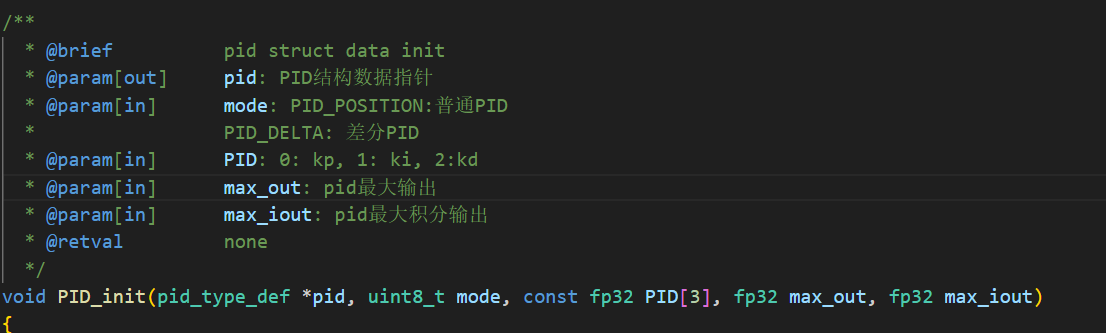
创建电机结构体变量,用于接收电机数据
这个函数写的是每按下一次按键,编码增加1024;
PID_clac函数是PID计算函数,填入PID结构体指针,反馈数据(即读到的电机数据),设定值,即可输出PID计算结果;
将角度外环的输出结果作为速度内环的SET值,再将速度环的输出给电机函数,即可完成串环控制
过零处理部分
float Handle_Angle8191_PID_Over_Zero(float tar, float cur) // 过零处理
{
    if(tar - cur > 4096)    // 4096:半圈机械角度
    {
        angle_test += 8191;  // 目标角度比当前角度大超过半圈,说明需要正向过零
    }
    else if(tar - cur < -4096)
    {
        angle_test = angle_test - 8191;  // 目标角度比当前角度小超过半圈,说明需要反向过零
    }
    else
    {
        // 不过零的情况,保持原值
    }
    return angle_test;
}
智能硬件社区聚焦AI智能硬件技术生态,汇聚嵌入式AI、物联网硬件开发者,打造交流分享平台,同步全国赛事资讯、开展 OPC 核心人才招募,助力技术落地与开发者成长。
更多推荐



 5
5 0
0- 0


 已为社区贡献4条内容

所有评论(0)