第05章:Tools (上)
1、Tools概述
1.1 工具的重要性
要构建更强大的AI工程应用,只有生成文本这样的“ 纸上谈兵 ”能力自然是不够的。
工具是赋予大语言模型 与外部世界交互能力 的关键组件,从而能让智能体执行搜索、计算、数据库查 询、邮件发送或调用第三方API等,进而构建功能强大的AI应用。借助工具,大模型才能从“ 认识世界 ” 走向“ 改变世界 ”。
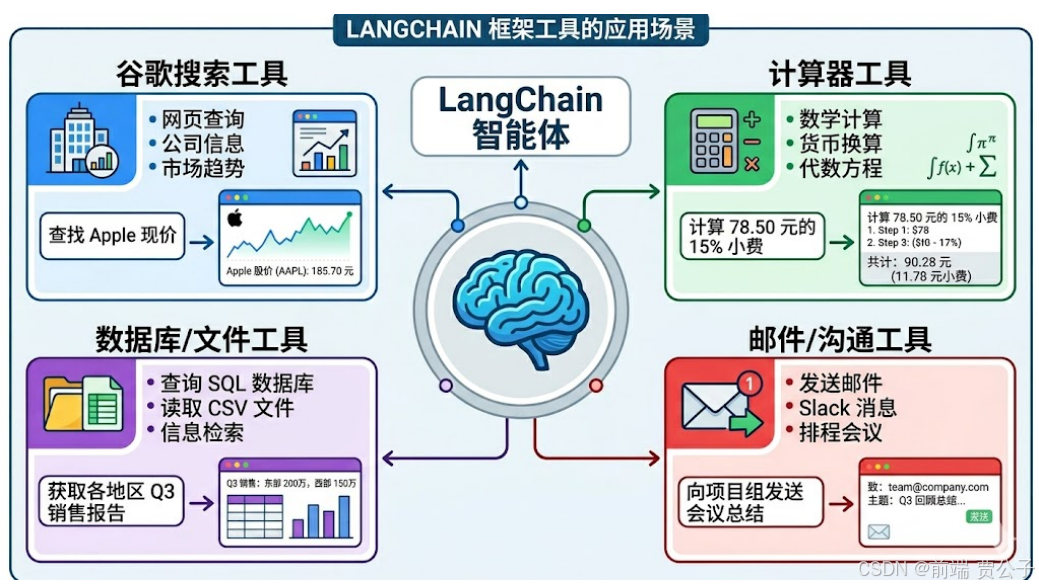
工具是构建智能体的核心要素之一!
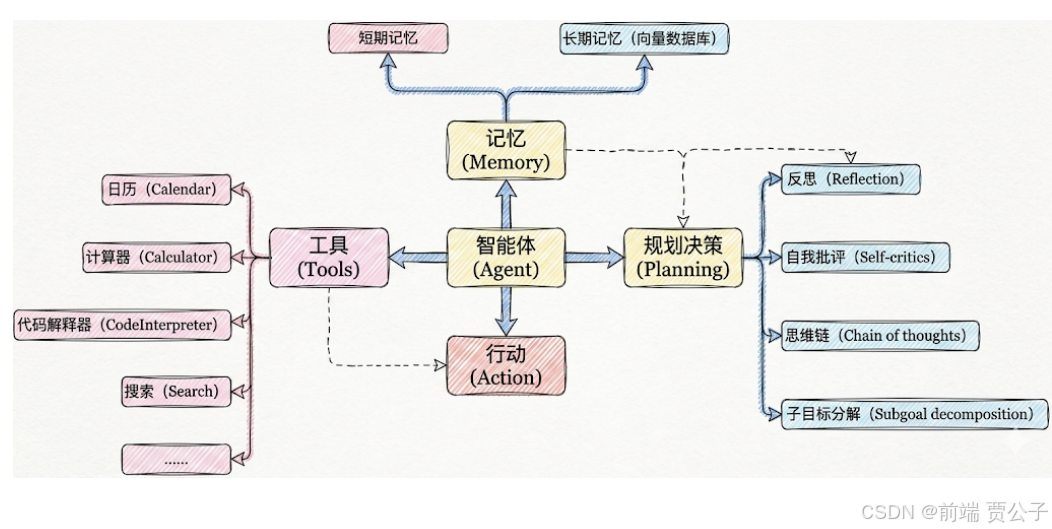
1.2 工具调用的方式
在LangChain中,工具(Tools)实际上是指明确定义了输入和输出的 可调用函数 。因此, 工具调用 (Tool Calling) 也被称为 函数调用(Function Calling) 。
具体有两种调用方式
方式1:直接调用
这种方式,适合测试时使用。
from langchain_core.tools import tool

@tool
def get_weather(city: str) -> str:
 """
获取指定城市的天气信息
参数:
city: 城市名称,如"北京"、"上海"
返回:
天气信息字符串
 """
# 你的实现
 return city + "晴天,温度 15°C"

result = get_weather.invoke({"city": "北京"})
print(result)
方式2:绑定到模型(主流)
这种方式,让AI来调用,开发中使用。
from langchain.chat_models import init_chat_model
import os
from dotenv import load_dotenv
from langchain_core.tools import tool

load_dotenv(override=True)

# 1. 基础配置
MODEL_NAME = "deepseek-v4-flash"
# 2. 初始化模型
model = init_chat_model(
    model=MODEL_NAME,
    model_provider="openai",
    api_key=os.getenv("DEEPSEEK_API_KEY"),
    base_url=os.getenv("DEEPSEEK_BASE_URL"),
)

# 定义工具
@tool
def get_weather(city: str) -> str:
 """获取指定城市的天气"""
# 你的实现
 return "晴天,温度 15°C"

# 绑定工具
model_with_tools = model.bind_tools([get_weather])
# AI 可以决定是否调用工具
response = model_with_tools.invoke("北京天气如何?")

# response = model_with_tools.invoke("2 + 3 = ?")
# 检查 AI 是否要调用工具
if response.tool_calls:
 print("AI 想调用工具:", response.tool_calls)
else:
 print("AI 直接回答:", response.content)
1.3 工具调用的整体流程
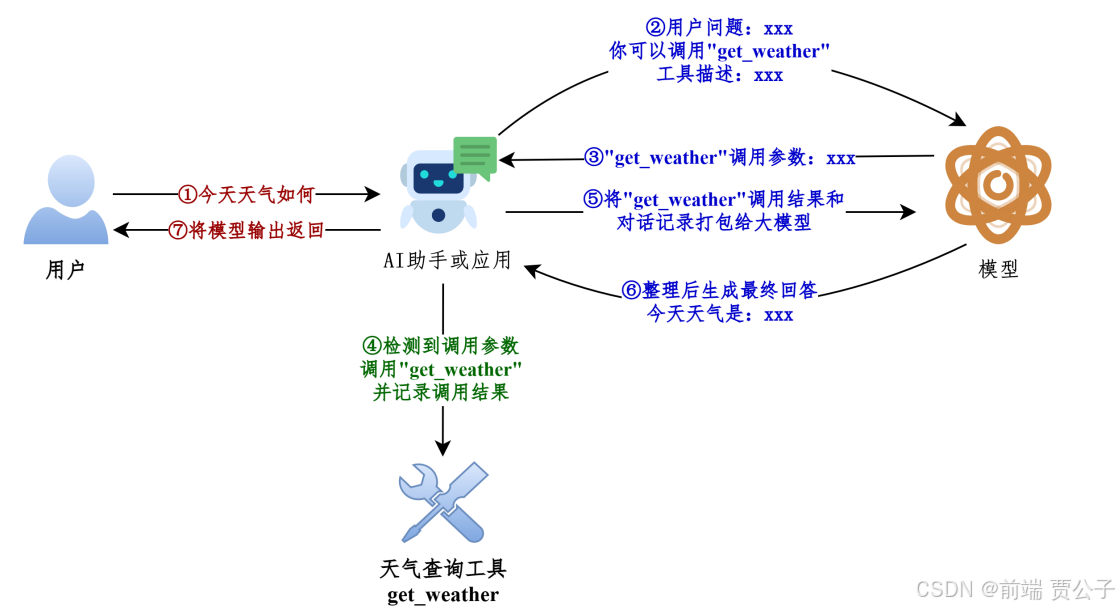
大模型能根据对话上下文决定何时调用工具以及传递哪些参数。
经典流程如下:
用户
 │
 │ ① 发起问题
 │ 例如:"今天北京天气如何?"
 ▼
AI 助手(Application)
 │
 │ ② 将用户问题发送给大模型
 ▼
大模型(LLM)
 │
 │ ③ 分析用户意图
 │ 判断需要调用 get_weather 工具
 │ 返回 Tool Call:
 │    tool = get_weather
 │    city = 北京
 ▼
AI 助手(Application)
 │
 │ ④ 接收 Tool Call
 │ 调用 get_weather(city="北京")
 ▼
天气查询工具(get_weather)
 │
 │ 返回:
 │ "北京今天晴,30℃"
 ▼
AI 助手(Application)
 │
 │ ⑤ 将以下内容发送给大模型
 │ • 用户问题
 │ • Tool Call
 │ • Tool Result
 ▼
大模型(LLM)
 │
 │ ⑥ 根据工具结果生成最终回答
 │ "北京今天晴,30℃,适合外出。"
 ▼
AI 助手(Application)
 │
 │ ⑦ 返回最终回答
 ▼
用户
我们现在编写的LangChain应用对应上图中的AI助手或应用。
1.4 从Message流转看工具的调用
前提:模型的初始化
from langchain.chat_models import init_chat_model
import os
from dotenv import load_dotenv
from langchain_core.tools import tool

load_dotenv(override=True)

# 1. 基础配置
MODEL_NAME = "deepseek-v4-flash"
# 2. 初始化模型
model = init_chat_model(
    model=MODEL_NAME,
    model_provider="openai",
    api_key=os.getenv("DEEPSEEK_API_KEY"),
    base_url=os.getenv("DEEPSEEK_BASE_URL"),
)
使用@tool修饰
from langchain_core.tools import tool
from langchain_core.messages import HumanMessage, ToolMessage


@tool
def get_weather(city: str) -> str:
    """获取天气的工具"""
    return f"{city}天气晴朗~"


# 将模型和工具绑定
model_with_tools = model.bind_tools([get_weather])

# 初始消息
messages = [
    HumanMessage(content="今天北京天气如何")
]

# 第一次调用模型,模型决定是否调用工具
response = model_with_tools.invoke(messages)

# 添加 AIMessage
messages.append(response)

# 获取工具调用列表
tool_calls = response.tool_calls

for tool_call in tool_calls:
    if tool_call["name"] == "get_weather":
        # 返回的是 ToolMessage
        tool_response = get_weather.invoke(tool_call)

        print(type(tool_response))

        # 添加 ToolMessage
        messages.append(tool_response)

print("=====================> messages <=====================")

for msg in messages:
    msg.pretty_print()

print("=====================> messages <=====================")

# 第二次调用模型,让模型根据工具结果生成最终回答
final_response = model_with_tools.invoke(messages)

print("\n最终回答:")
final_response.pretty_print()
说明:被 @tool 修饰的函数可以调用 invoke 接收模型返回的入参信息执行函数,并返回 ToolMessage 实例,我们不再需要手动拼接 ToolMessage 。
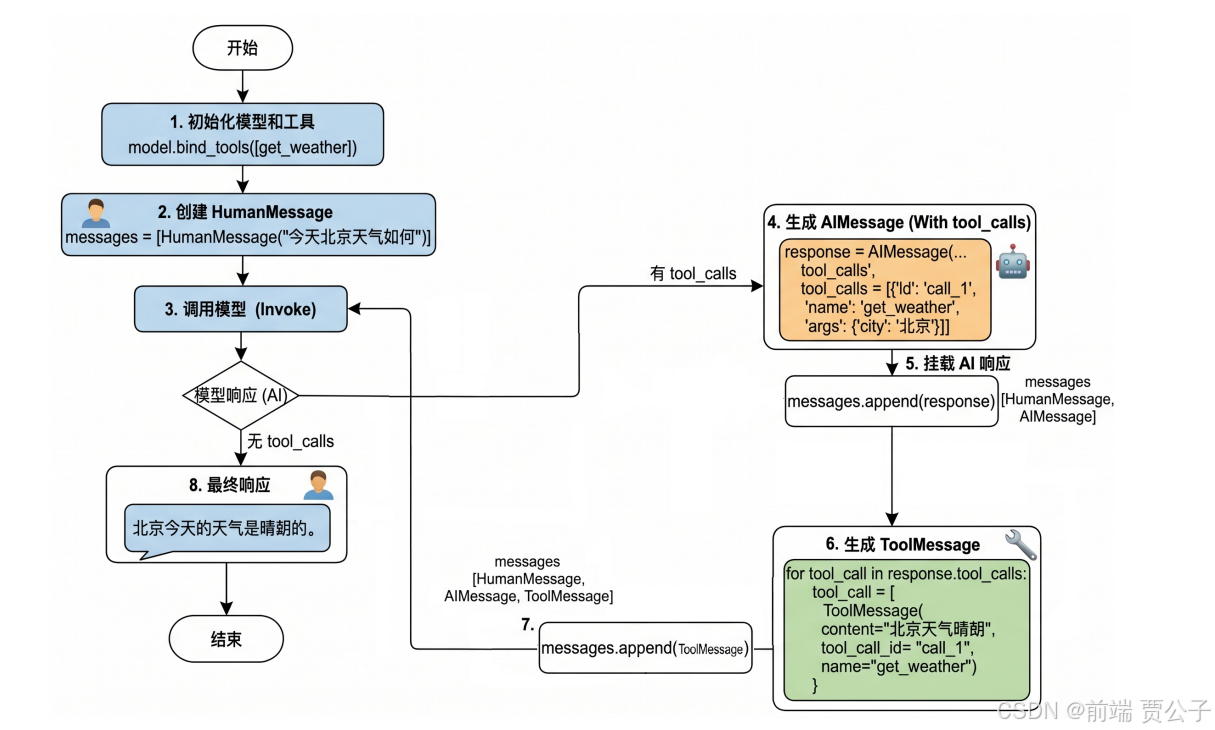
工具调用流程总结:
所以如果真正要大模型根据工具调用结果进行回复,完整的调用流程包括如下四个步骤:
- 步骤1:模型绑定工具 :通过model.bind_tools([...])绑定一个或者多个工具。
- 步骤2:模型生成工具调用请求 :用户输入问题,调用模型(比如invoke())。如果需要调用工具,模 型返回包含工具调用信息(如工具名称和参数)的AIMessage。
- 步骤3:开发者手动执行工具 :用户从响应中提取工具调用信息并手动调用对应的工具(比如工 具.invoke())。
- 步骤4:将工具执行结果ToolMessage传递给模型生成最终结果 :将之前用户提问内容和手动执行工具 结果ToolMessage返回模型,模型最终生成回复。
特别注意:大模型调用工具是单次推理,直接响应,需要开发者手动执行工具并管理循环,适合简 单、确定的任务。
2、工具的定义方式1:不使用@tool
2.1 模型绑定工具并发送请求
# 模型的初始化
from langchain.chat_models import init_chat_model
import os
from dotenv import load_dotenv
from rich import  print as  rprint


load_dotenv(override=True)

# 1. 基础配置
MODEL_NAME = "deepseek-v4-flash"
# 2. 初始化模型
model = init_chat_model(
    model=MODEL_NAME,
    model_provider="openai",
    api_key=os.getenv("DEEPSEEK_API_KEY"),
    base_url=os.getenv("DEEPSEEK_BASE_URL"),
)

# 声明一个函数「工具」
def get_weather(city:str):
    return  f"{city} 天气晴朗"

# 将函数定义在模型上
model_with_tools=model.bind_tools([get_weather])

# 调用模型
response= model_with_tools.invoke("北京的天气怎么样")

rprint(response)
输出如下
AIMessage(
    content='',
    additional_kwargs={'refusal': None},
    response_metadata={
        'token_usage': {
            'completion_tokens': 62,
            'prompt_tokens': 269,
            'total_tokens': 331,
            'completion_tokens_details': {
                'accepted_prediction_tokens': None,
                'audio_tokens': None,
                'reasoning_tokens': 17,
                'rejected_prediction_tokens': None
            },
            'prompt_tokens_details': {'audio_tokens': None, 'cached_tokens': 0},
            'prompt_cache_hit_tokens': 0,
            'prompt_cache_miss_tokens': 269
        },
        'model_provider': 'openai',
        'model_name': 'deepseek-v4-flash',
        'system_fingerprint': 'fp_8b330d02d0_prod0820_fp8_kvcache_20260402',
        'id': '557e69f0-1438-478d-817e-1d191421da5e',
        'finish_reason': 'tool_calls',
        'logprobs': None
    },
    id='lc_run--019f2bb7-1d19-7742-abb1-9692e9273da2-0',
    tool_calls=[
        {
            'name': 'get_weather',
            'args': {'city': '北京'},
            'id': 'call_00_zQTT06q4uq2gwNA8UGbi8655',
            'type': 'tool_call'
        }
    ],
    invalid_tool_calls=[],
    usage_metadata={
        'input_tokens': 269,
        'output_tokens': 62,
        'total_tokens': 331,
        'input_token_details': {'cache_read': 0},
        'output_token_details': {'reasoning': 17}
    }
)
2.2 工具描述的各部分详解
2.2.1 了解:convert_to_openai_too
执行 model.bind_tools([get_weather]) ,底层最终会调用 convert_to_openai_tool 生成工具描述。所 以我们可以直接调用后者查看解析后的工具描述。
from langchain_core.utils.function_calling import convert_to_openai_tool
from rich import print as rprint

def get_weather(city: str):
 return f"{city}天气晴朗"

rprint(convert_to_openai_tool(get_weather))
输出如下
{
    'type': 'function',
    'function': {
        'name': 'get_weather',
        'description': '',
        'parameters': {'properties': {'city': {'type': 'string'}}, 'required': ['city'], 'type': 'object'}
    }
}
结果字段说明:
(1) type:定义当前数据节点必须是什么数据类型。常见类型有 string, number, integer, boolean, object, array, null。object即是json对象。
(2) properties:用于定义JSON 对象(Object)中可以包含哪些属性(键),以及每个属性对应的 值类型和说明。
(3) required:当 type为 "object"时使用,是一个数组,列出了对象中必须存在的属性名。
问题:为什么不使用@tool装饰器修饰的函数,也可以理解为工具呢?
查看 convert_to_openai_tool 底层源码
   elif isinstance(function, langchain_core.tools.base.BaseTool):
        oai_function = cast("dict", _format_tool_to_openai_function(function))
    elif callable(function):
        oai_function = cast(
            "dict", _convert_python_function_to_openai_function(function)
        )
相当于加了@tool修饰的函数走上面的分支,没有加@tool修饰的函数走下面的分支,后者会基于函数定 义和docstring生成pydantic模式的描述,然后转换为规范的tool_schema。
2.2.2 description说明
convert_to_openai_tool 会从 docstring(文档字符串) 加载工具的描述信息,上面的案例中, docstring 为空,所以抽取的 description 为空。
docstring,文档字符串,使用三个双引号表示开始和结束。
from langchain_core.utils.function_calling import convert_to_openai_tool
from rich import print as rprint

def get_weather(city: str):
   """
    天气查询工具
   """
   return f"{city}天气晴朗"

rprint(convert_to_openai_tool(get_weather))
{
    'type': 'function',
    'function': {
        'name': 'get_weather',
        'description': '天气查询工具',
        'parameters': {'properties': {'city': {'type': 'string'}}, 'required': ['city'], 'type': 'object'}
    }
}
2.2.3 参数说明
convert_to_openai_tool 会从 docstring 加载参数说明,这里的 docstring 必须遵循 Google 风格
- Google 风格 docstring 说明:https://google.github.io/styleguide/pyguide.html
- Google 风格 docstring 示例:https://www.sphinx-doc.org/en/master/usage/extensions/exa mple_google.html
- Python docstring 通用约定:https://peps.python.org/pep-0257/
基础用法不必完整阅读规范,只需要按照下面的示例仿写即可。
from langchain_core.utils.function_calling import convert_to_openai_tool
from rich import print as rprint

def get_weather(city: str):
   """
    天气查询工具

    Args:
        city: 具体的城市

    returns
        返回城市的信息
   """
   return f"{city}天气晴朗"

rprint(convert_to_openai_tool(get_weather))
AI 依赖 docstring 来理解工具。
2.2.4 参数类型说明
参数类型来源于函数的类型注解。
from langchain_core.utils.function_calling import convert_to_openai_tool
from rich import print as rprint

def get_weather(city):
   """
    天气查询工具
   """
   return f"{city}天气晴朗"

rprint(convert_to_openai_tool(get_weather))
删除了参数类型注解,则工具描述中不包含参数类型说明
注意:如果docstring中包含参数说明,则对应的参数必须有类型注解,否则报错
from langchain_core.utils.function_calling import convert_to_openai_tool
from rich import print as rprint

def get_weather(city):
   """
    天气查询工具

    Args:
        city: 具体的城市

    returns
        返回城市的信息
   """
   return f"{city}天气晴朗"

rprint(convert_to_openai_tool(get_weather))
报错如下:
ValueError: Arg city in docstring not found in function signature.
2.2.5 参数默认值说明
如果参数没有默认值,则会包含 在required对应的列表 中。
反之,则参数的描述信息会包含 default 字段,并且 不会出现在required列表 中
def get_weather(city: str = "北京"):
   """
    天气查询工具

    Args:
        city: 具体的城市

    returns
        返回城市的信息
   """
   return f"{city}天气晴朗"

rprint(convert_to_openai_tool(get_weather))
输出如下
{
    'type': 'function',
    'function': {
        'name': 'get_weather',
        'description': '天气查询工具',
        'parameters': {
            'properties': {'city': {'default': '北京', 'description': '具体的城市', 'type': 'string'}},
            'type': 'object'
        }
    }
}
目前只有一个参数,并且有默认值,所以required字段被移除了
举例2:
from langchain_core.utils.function_calling import convert_to_openai_tool
from rich import print as rprint

def get_weather(dt:str,city: str = "北京"):
   """
    天气查询工具

    Args:
        dt: 日期
        city: 具体的城市

    returns
        返回城市的信息
   """
   return f"{city}天气晴朗"

rprint(convert_to_openai_tool(get_weather))
输出
{
    'type': 'function',
    'function': {
        'name': 'get_weather',
        'description': '天气查询工具',
        'parameters': {
            'properties': {
                'dt': {'description': '日期', 'type': 'string'},
                'city': {'default': '北京', 'description': '具体的城市', 'type': 'string'}
            },
            'required': ['dt'],
            'type': 'object'
        }
    }
}
3、工具的定义方式2:使用@tool装饰器(推荐)
使用 @tool 装饰器修饰,可以自动将普通 Python 函数转化为智能体可调用的工具。
此方式 最直接 ,代码量极少,非常适合快速验证想法或创建参数简单的工具。
3.1 自定义工具描述:description
情况1:仅提供docstring信息
在bind_tools()调用时,先将函数封装为 BaseTool 类型的对象,再传递给 convert_to_openai_tool 函 数,生成工具的描述。
from langchain_core.utils.function_calling import convert_to_openai_tool
from rich import  print as  rprint
from langchain.tools import tool

@tool
def get_weather(city: str):
 return f"{city}天气晴朗"

rprint(convert_to_openai_tool(get_weather))
@tool 会从 docstring 生成描述信息,同样要求遵循 Google docstring 规范 。如果没有 docstring 则报错,如下。
ValueError: Function must have a docstring if description not provided.
补充 docstring
from langchain_core.utils.function_calling import convert_to_openai_tool
from rich import  print as  rprint
from langchain.tools import tool

@tool
def get_weather(city: str):
   """
    获取城市信息
   """
   return f"{city}天气晴朗"

rprint(convert_to_openai_tool(get_weather))
输出如下
{
'type': 'function',
'function': {
'name': 'get_weather',
'description': '获取城市信息',
'parameters': {'properties': {'city': {'type': 'string'}}, 'required': ['city'], 'type': 'object'}
}
}
情况2:添加工具描述:description
@tool 的参数 description 可以更改工具描述,优先级高于 docstring 的函数说明
from langchain_core.utils.function_calling import convert_to_openai_tool
from rich import  print as  rprint
from langchain.tools import tool

@tool(description="获取具体的提示信息")
def get_weather(city: str):
   """
    获取城市信息
   """
   return f"{city}天气晴朗"

rprint(convert_to_openai_tool(get_weather))
{
    'type': 'function',
    'function': {
        'name': 'get_weather',
        'description': '获取具体的提示信息',
        'parameters': {'properties': {'city': {'type': 'string'}}, 'required': ['city'], 'type': 'object'}
    }
}
情况3:解析docstring:parse_docstring
当我们没有向 @tool 传递 description 参数时,默认情况下, tool 会将 docstring 整体视为 description ,如下
from langchain_core.utils.function_calling import convert_to_openai_tool
from rich import  print as  rprint
from langchain.tools import tool

@tool
def get_weather(city: str):
   """
   获取城市信息

   Args:
      city: 城市
   """
   return f"{city}天气晴朗"

rprint(convert_to_openai_tool(get_weather))
输出如下
{
    'type': 'function',
    'function': {
        'name': 'get_weather',
        'description': '获取城市信息\n\nArgs:\n   city: 城市',
        'parameters': {'properties': {'city': {'type': 'string'}}, 'required': ['city'], 'type': 'object'}
    }
}
通过将 parse_docstring 设置为True,docstring会被解析,填充到相应的字段描述中。
from langchain_core.utils.function_calling import convert_to_openai_tool
from rich import  print as  rprint
from langchain.tools import tool

@tool(parse_docstring=True)
def get_weather(city: str):
   """
   获取城市信息

   Args:
      city: 城市
   """
   return f"{city}天气晴朗"

rprint(convert_to_openai_tool(get_weather))
输出
{
    'type': 'function',
    'function': {
        'name': 'get_weather',
        'description': '获取城市信息',
        'parameters': {
            'properties': {'city': {'description': '城市', 'type': 'string'}},
            'required': ['city'],
            'type': 'object'
        }
    }
}
要注意:不使用 @tool 装饰器时,docstring不合法会被视为普通文本,作为 description ,但如果使 用了 @tool 时 docstring 不合法,将会抛出异常
3.2 更改工具名称:name_or_callable
默认情况,使用函数名作为工具名称,但可以向@tool 传参 name_or_callable ,以更改工具名称
from langchain_core.utils.function_calling import convert_to_openai_tool
from rich import  print as  rprint
from langchain.tools import tool

@tool(parse_docstring=True,name_or_callable="getWeather")
def get_weather(city: str):
   """
   获取城市信息

   Args:
      city: 城市
   """
   return f"{city}天气晴朗"

rprint(convert_to_openai_tool(get_weather))
{
    'type': 'function',
    'function': {
        'name': 'getWeather',
        'description': '获取城市信息',
        'parameters': {
            'properties': {'city': {'description': '城市', 'type': 'string'}},
            'required': ['city'],
            'type': 'object'
        }
    }
}
说明:@tool中参数name_or_callable名称可以省略
from langchain_core.utils.function_calling import convert_to_openai_tool
from rich import  print as  rprint
from langchain.tools import tool

@tool("getWeather")
def get_weather(city: str):
   """
   获取城市信息

   Args:
      city: 城市
   """
   return f"{city}天气晴朗"

rprint(convert_to_openai_tool(get_weather))
输出如下
{
    'type': 'function',
    'function': {
        'name': 'getWeather',
        'description': '获取城市信息\n\nArgs:\n   city: 城市',
        'parameters': {'properties': {'city': {'type': 'string'}}, 'required': ['city'], 'type': 'object'}
    }
}
说明:不要使用config或runtime作为参数名,这些是LangChain内部保留的。
开发中,习惯使用函数名作为工具名称,不推荐自定义工具名称。
3.3 自定义args_schema
3.3.1 方式1:使用Pydantic模型定义
当工具的参数变得复杂,需要 枚举值 、 范围限制 或 更复杂的业务逻辑验证 时,Pydantic 模型是理想 的选择,提供强大的类型检查和数据验证
使用Pydantic 的主要优势在于能够精确控制工具参数的格式和验证规则,让大模型更准确地理解如何调 用工具
3.3.1.1 pydantic类型的定义
① BaseModel基类
通过继承核心基类 BaseModel 定义数据模型,从而声明字段结构、类型约束、默认值以0及校验规则。
from pydantic import BaseModel
class WeatherInput(BaseModel):
  city: str
print(WeatherInput(city="北京"))
输出如下
city='北京'
注意:BaseModel子类初始化时,不接收位置参数,字段值必须以关键字参数的形式传入,否则 报错。
from pydantic import BaseModel
class WeatherInput(BaseModel):
  city: str
print(WeatherInput("北京"))
报错如下
TypeError: BaseModel.__init__() takes 1 positional argument but 2 were given
这是因为BaseModel的初始化函数签名如下
def __init__(self, /, **data: Any) -> None:由此可知,所有关键字参数都会被收集到字典 data 中,然后 data 会按照参数类型注解进行校验,失 败时抛出异常。
② Field
Field() :用来“ 定制字段 ”的函数,可用于设置默认值、描述等
举例1:设置默认值
from pydantic import BaseModel, Field
class WeatherInput(BaseModel):
    city: str = Field(
        default= "北京"
)
print(WeatherInput())
举例2:设置参数的描述信息
每个字段的 description 参数至关重要,它直接影响大模型理解参数含义的能力。
from pydantic import BaseModel, Field


class WeatherInput(BaseModel):
    city: str = Field(
        default="北京",
        description="城市",
    )

    include_forecast: bool = Field(
        default=False,
        description="是否包含未来五日天气预报",
    )


print(WeatherInput())
③ Literal
可以使用 Literal类型限定参数为固定选项。
Literal :表示字段不能是任意某种类型的值,而只能是几个固定字面量之一
from typing import Literal

from pydantic import BaseModel


class WeatherInput(BaseModel):
    city: str
    unit: Literal["celsius", "fahrenheit"]


print("===============> 合法 <===============")
print(WeatherInput(city="北京", unit="celsius"))

print("===============> 非法 <===============")
try:
    print(WeatherInput(city="北京", unit="kelvin"))
except Exception as e:
    print("报错类型:", type(e).__name__)
    print(e)
3.3.1.2 使用Pydantic定义args_schema
通过 @tool(args_schema=PydanticModelCls) 将这个 Pydantic 模型与工具函数关联。 利用 Pydantic 的类型系统进行参数验证,当大模型需要调用工具前,Pydantic 会自动验证参数的类型 和有效性。
import os

from dotenv import load_dotenv
from langchain.chat_models import init_chat_model
from rich import print as rprint

load_dotenv(override=True)

# 1. 基础配置
MODEL_NAME = "deepseek-v4-flash"
# 2. 初始化模型
model = init_chat_model(
    model=MODEL_NAME,
    model_provider="openai",
    api_key=os.getenv("DEEPSEEK_API_KEY"),
    base_url=os.getenv("DEEPSEEK_BASE_URL"),
)
from langchain.tools import tool
from pydantic import BaseModel, Field
from langchain_core.utils.function_calling import convert_to_openai_tool
# Schema
class WeatherSchema(BaseModel):
city: str = Field(default="北京", description="城市名称")
if_forecast: bool = Field(default=False, description="是否包含明日天气预报")
# 定义工具
@tool("get_weather_and_forecast",description="查询当日天气,可以包含明日天气预报",args_schema=WeatherSchema)
def get_weather(city: str, if_forecast: bool):
res = f"{city} 今天天气不错"
if if_forecast:
res += "\n明天也不错"
return res
rprint(convert_to_openai_tool(get_weather))
{
    'type': 'function',
    'function': {
        'name': 'get_weather_and_forecast',
        'description': '查询当日天气,可以包含明日天气预报',
        'parameters': {
            'properties': {
                'city': {'default': '北京', 'description': '城市名称', 'type': 'string'},
                'if_forecast': {'default': False, 'description': '是否包含明日天气预报', 'type': 'boolean'}
            },
            'type': 'object'
        }
    }
}
3.3.2 方式2:使用Json Schema定义
在 LangChain 中,还可以直接使用 JSON Schema 字典 来定义工具的参数模式。这种方式提供了极大 的灵活性。
因为工具参数模式可以基于数据库配置或用户输入在 运行时动态生成 ,所以这种方式特别适合参数结 构需要动态生成的场景。
举例:
{
  "type": "function",
  "function": {
    "name": "get_weather",
    "description": "获取当日天气,可选未来五日天气预报",
    "parameters": {
      "type": "object",
      "properties": {
        "location": {
          "type": "string"
        },
        "units": {
          "type": "string"
        },
        "include_forecast": {
          "type": "boolean"
        }
      },
      "required": [
        "location",
        "units",
        "include_forecast"
      ]
    }
  }
}
应该传递给args_schema的只有 parameters 对应的JSON字符串,即
{
  "type": "object",
  "properties": {
    "location": {
      "type": "string"
    },
    "units": {
      "type": "string"
    },
    "include_forecast": {
      "type": "boolean"
    }
  },
  "required": [
    "location",
    "units",
    "include_forecast"
  ]
}
举例: 通过 @tool(args_schema=json_schema_dict) 将一个符合 JSON Schema 标准的字典与工具函数关 联。
from langchain.tools import tool
from langchain_core.utils.function_calling import convert_to_openai_tool


weather_schema = {
    "type": "object",
    "properties": {
        "location": {
            "type": "string"
        },
        "units": {
            "type": "string"
        },
        "include_forecast": {
            "type": "boolean"
        }
    },
    "required": [
        "location",
        "units",
        "include_forecast"
    ]
}


@tool(args_schema=weather_schema)
def get_weather(
    city: str,
    unit: str = "celsius",
    include_forecast: bool = False
) -> str:
    """
    获取当日天气,可选未来五日天气预报

    Args:
        city: 城市名称
        unit: 温度单位,celsius 表示摄氏度,fahrenheit 表示华氏度
        include_forecast: 是否包含未来五天天气预报
    """

    temp = 22 if unit == "celsius" else 72

    result = (
        f"{city}当天气温: "
        f"{temp} "
        f"{'摄氏度' if unit == 'celsius' else '华氏度'}"
    )

    if include_forecast:
        result += "\n未来五天都是晴天"

    return result


print(convert_to_openai_tool(get_weather))
{
'type': 'function',
'function': {
'name': 'get_weather',
'description': '获取当日天气,可选未来五日天气预报...',
'parameters': {
'type': 'object',
'properties': {
'location': {
'type': 'string'
},
'units': {
'type': 'string'
},
'include_forecast': {
'type': 'boolean'
}
},
'required': [
'location',
'units',
'include_forecast'
]
}
}
}

智能硬件社区聚焦AI智能硬件技术生态,汇聚嵌入式AI、物联网硬件开发者,打造交流分享平台,同步全国赛事资讯、开展 OPC 核心人才招募,助力技术落地与开发者成长。
更多推荐
 0
0 0
0- 0


 已为社区贡献2条内容

所有评论(0)