Industrial AI Cameras: Turning Visual Data into Manufacturing Decisions
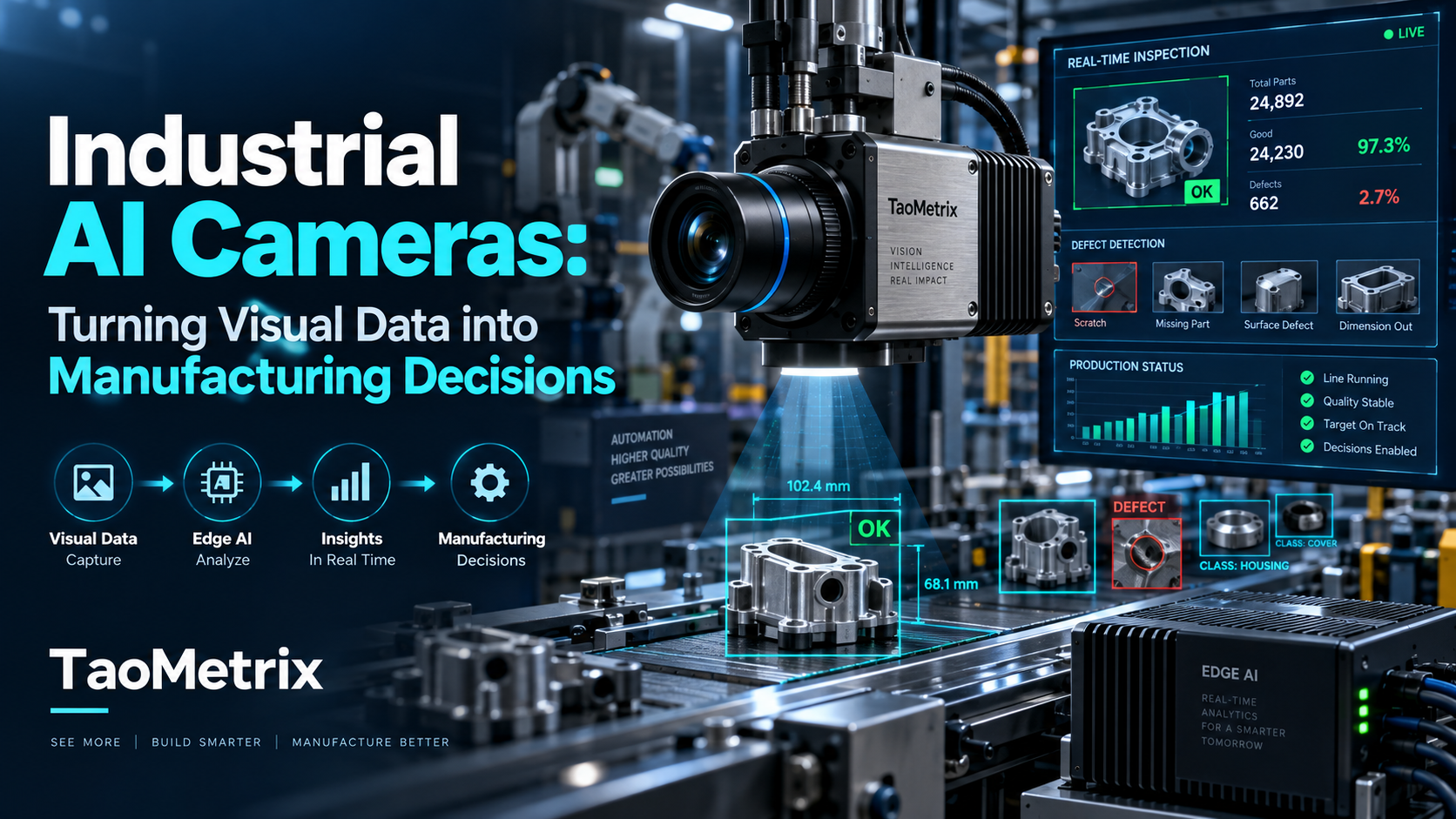
Industrial AI cameras are becoming an important part of modern manufacturing. They can inspect products, monitor production lines, detect safety risks, verify assembly steps, and help factories respond to problems earlier.
However, an industrial AI camera is much more demanding than a consumer security camera. It must deliver stable performance in a controlled but demanding production environment, often operating for long hours with strict requirements for accuracy, traceability, response time, and reliability.
At TaoMetrix, we support AI hardware teams developing industrial cameras and edge vision terminals—from product definition and engineering prototypes to pilot production and OEM/ODM manufacturing.
What Can Industrial AI Cameras Do?
Industrial AI vision systems can support tasks such as:
- Detecting assembly defects
- Checking component presence and orientation
- Reading barcodes and labels
- Monitoring worker safety
- Identifying equipment abnormalities
- Counting products on a production line
- Verifying packaging
- Checking cable routing and connector placement
- Monitoring process compliance
- Supporting robotic guidance
The purpose is not simply to capture more images. It is to convert visual information into a useful production decision.
For example, an industrial AI camera may determine whether a component is correctly installed, whether a product should move to the next station, or whether an operator should receive an alert.
Why Industrial Vision Projects Are Difficult
Factory Conditions Are Not Perfect
Industrial environments may include:
- Uneven lighting
- Reflections from metal surfaces
- Dust and vibration
- Fast-moving products
- Similar-looking components
- Changing production materials
- Limited installation space
- Long operating hours
A model that performs well in a laboratory may behave differently on a real production line.
This is why industrial AI cameras require testing under the specific conditions where they will be installed.
Accuracy Must Be Defined Clearly
“High accuracy” is not a sufficient engineering requirement.
A project should define:
- What counts as a defect
- The minimum detectable feature size
- Acceptable false positives
- Acceptable false negatives
- Required response time
- Acceptable inspection rate
- What happens when the system is uncertain
- Whether human review is required
These definitions determine the camera, lens, lighting, processor, AI model, storage, and test requirements.
The Hardware Behind an Industrial AI Camera
A typical industrial AI vision terminal may include:
- Image sensor
- Lens
- Lighting interface
- Application processor
- NPU, VPU, GPU, or CPU
- Memory and storage
- Ethernet, Wi-Fi, or industrial networking
- Digital and analog interfaces
- Power-management system
- Cooling or heat-dissipation structure
- Industrial enclosure
- Mounting hardware
- Firmware and device-management software
Every component must be selected according to the application environment and production requirements.
For example, a camera designed for stationary inspection may have different requirements from a camera mounted on a moving robot. A device installed near machinery may need stronger vibration resistance and more robust connectors.
Five Design Questions for Industrial AI Camera Projects
1. What Is the Inspection Target?
The team should define the exact item or event the camera needs to recognize.
Examples include:
- Missing components
- Incorrect orientation
- Scratches
- Surface contamination
- Assembly gaps
- Cable errors
- Label problems
- Unsafe human behavior
- Equipment leakage or overheating
A clear target helps the team choose the right image resolution, lens, lighting, and model architecture.
2. What Is the Required Inspection Speed?
The system should be designed around the production cycle.
Important questions include:
- How many products must be inspected per minute?
- How much time is available at each station?
- Must the camera inspect one product or several at once?
- Can the production line stop for an alert?
- Does the system need to respond immediately?
- Is batch analysis acceptable?
The answer directly affects camera frame rate, processor performance, memory, storage, and network design.
3. Can the System Operate Locally?
Local edge processing may be preferred when the system needs:
- Low latency
- Offline operation
- Reduced network traffic
- Local data control
- Immediate machine response
- Predictable operating costs
Cloud connectivity may still be useful for centralized dashboards, historical analysis, fleet management, and model updates.
Many industrial vision systems use a hybrid architecture.
4. How Will the Device Be Installed?
Mechanical installation affects image quality and long-term reliability.
The project should consider:
- Mounting angle
- Working distance
- Vibration
- Dust and moisture
- Cable routing
- Lighting position
- Maintenance access
- Heat dissipation
- Adjustment and calibration
An excellent camera cannot compensate for unstable mounting or poor lighting.
5. How Will the Product Be Tested?
Before mass production, the manufacturer needs a clear test strategy.
Testing may include:
- Power-on verification
- Camera and sensor detection
- Image-quality checks
- Network testing
- Storage testing
- Firmware programming
- AI inference checks
- Interface testing
- Thermal monitoring
- Long-duration operation
- Enclosure and connector inspection
A production test should be reliable, repeatable, and fast enough to fit the manufacturing process.
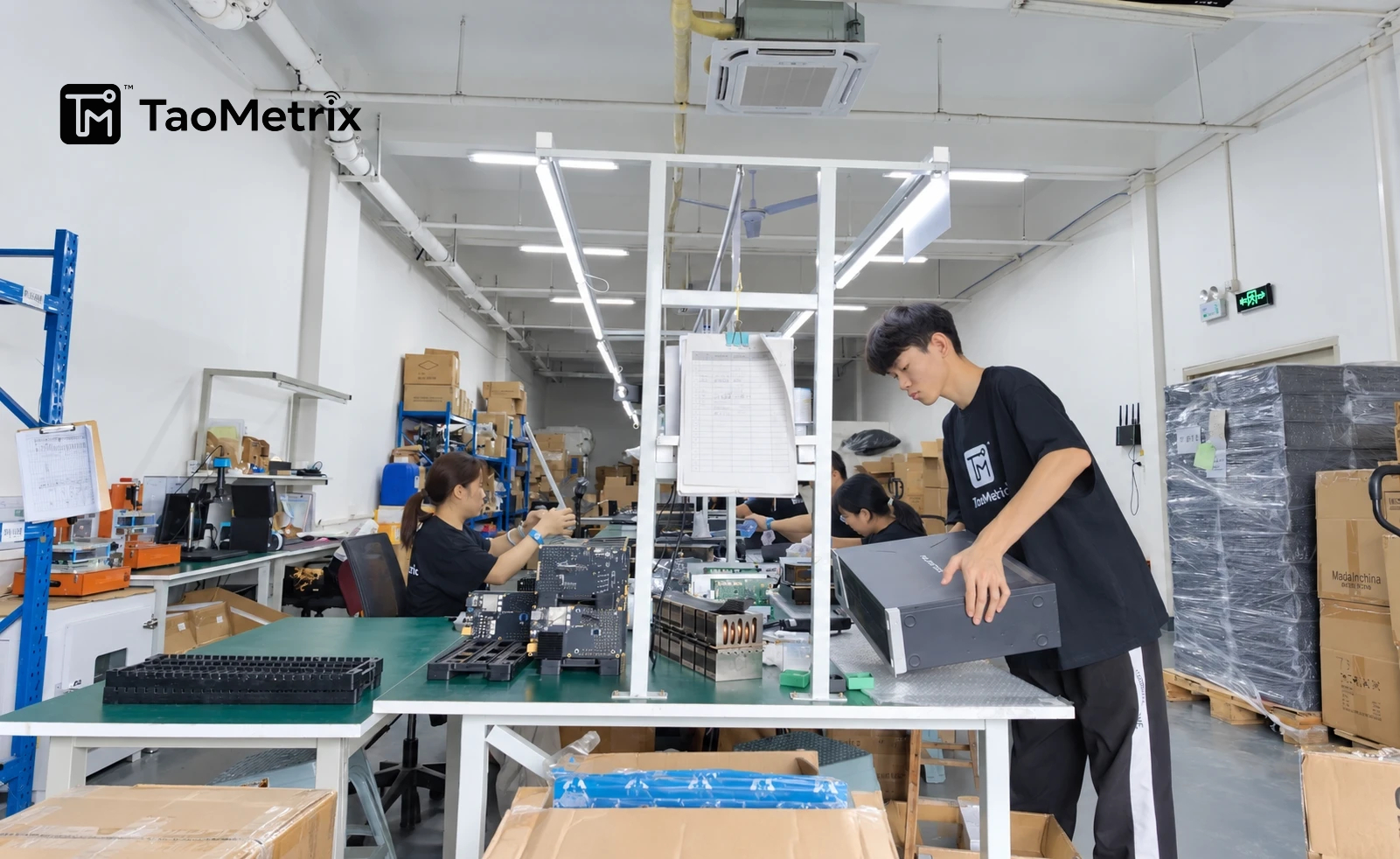
How TaoMetrix Supports Industrial AI Vision Hardware
TaoMetrix supports industrial AI camera projects through:
Product and Application Review
We review the inspection task, production environment, target performance, expected volume, and deployment requirements.
Hardware and System Integration
We can coordinate the integration of:
- Camera sensors and lenses
- Edge AI processors
- Memory and storage
- Networking modules
- Power systems
- Industrial interfaces
- Thermal structures
- Enclosures and mounting components
Engineering Prototype Development
Prototype units can be used to validate image quality, AI performance, installation, power consumption, thermal behavior, and software integration.
DFM and DFT Preparation
Before production, we review:
- Assembly sequence
- Fixture requirements
- Programming procedures
- Camera calibration
- Functional test coverage
- Quality inspection standards
- Traceability requirements
Pilot Production and OEM/ODM Support
TaoMetrix can support pilot builds and production introduction using production-intent materials, processes, fixtures, and testing methods.
According to information published on the TaoMetrix website, our Shenzhen manufacturing facility covers approximately 20,000 square meters and includes 12 SMT production lines, 6 DIP assembly lines, and 4 final assembly lines.
Common Industrial AI Camera Problems
Industrial vision projects may encounter:
- Poor performance under changing light
- Reflections on metal or glossy surfaces
- Camera movement caused by vibration
- Lens distortion
- Insufficient processing power
- Excessive thermal buildup
- Unstable network connections
- Slow production testing
- Poor calibration repeatability
- Lack of field-service planning
- Inconsistent component supply
These problems are easier to resolve when identified during product definition or prototype development rather than after production tooling and deployment.
What Customers Should Prepare
To begin an industrial AI camera project, customers should prepare:
- Inspection or monitoring objective
- Factory or installation environment
- Target object and defect types
- Required inspection speed
- Lighting conditions
- Camera and lens preferences
- AI model requirements
- Power and network conditions
- Expected production quantity
- Target market
- Required certifications
- Current project stage
- Available BOM, CAD, Gerber files, specifications, videos, or samples
For confidential designs, software, samples, and customer data, the review should take place under an appropriate NDA.
Frequently Asked Questions
What is the difference between an industrial AI camera and a security camera?
A security camera is primarily designed to monitor and record. An industrial AI camera is designed to make structured decisions, such as identifying defects, verifying assembly, guiding machinery, or triggering production actions.
Does an industrial AI camera always need a cloud connection?
No. Many industrial systems use edge processing for fast local decisions and cloud or server connections for dashboards, historical data, and model management.
Can an industrial AI camera replace human inspection?
It depends on the application. AI vision can improve consistency and speed, but many systems still use human review for uncertain cases, exceptions, and final quality decisions.
What is the most important factor in industrial vision?
The most important factor is the match between the visual task, image system, AI model, installation environment, testing method, and production workflow.
Conclusion
Industrial AI cameras are more than cameras with software added on top. They are complete systems that connect image capture, AI inference, production data, machine response, and manufacturing execution.
TaoMetrix helps global customers develop and manufacture AI vision hardware that can operate in real industrial environments.
From visual inspection to production intelligence, TaoMetrix helps turn industrial AI concepts into reliable hardware.
智能硬件社区聚焦AI智能硬件技术生态,汇聚嵌入式AI、物联网硬件开发者,打造交流分享平台,同步全国赛事资讯、开展 OPC 核心人才招募,助力技术落地与开发者成长。
更多推荐
 1
1 0
0- 0


 已为社区贡献1条内容

所有评论(0)